n-(2-aminoethyl)piperazine n-(2-aminoethyl)piperazine
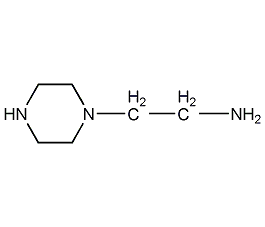
structural formula
| business number | 03sy |
|---|---|
| molecular formula | c6h15n3 |
| molecular weight | 129.20 |
| label |
n-aminoethylpiperazine, aminoethylpiperazine, aminoethyl-p-diazepine, 2-piperazinoethylamine, surfactant, corrosion inhibitors, hardener |
numbering system
cas number:140-31-8
mdl number:mfcd00005971
einecs number:205-411-0
rtecs number:tk8050000
brn number:104363
pubchem number:24890984
physical property data
1. properties: colorless or light yellow transparent liquid.
2. density (g/ml, 25/4℃): 0.9853colorless or light yellow transparent liquid. 0.989
3. relative vapor density (g/ml, air=1): undetermined
4. melting point (ºc): undetermined
5. boiling point (ºc, normal pressure): 210~230
6. boiling point (ºc, 5.2kpa): not available determined
7. refractive index: 1.500
8. flash point (ºc): 93
9. specific rotation (º): undetermined
p>
10. autoignition point or ignition temperature (ºc): undetermined
11. vapor pressure (kpa, 25ºc): undetermined
12. saturated vapor pressure (kpa, 60ºc): undetermined
13. heat of combustion (kj/mol): undetermined
14. critical temperature (ºc): undetermined
15. critical pressure (kpa): undetermined
16. log value of oil-water (octanol/water) partition coefficient: undetermined
17. explosion upper limit (%, v /v): undetermined
18. lower explosion limit (%, v/v): undetermined
19. solubility: soluble in water.
toxicological data
acute toxicity:
oral ld50 1500mg/kg(ckn)
2140ul/kg(rat)
skin ld50 880ul/kg(rbt)
skin irritation severe 5mg/24h(rbt)
main irritating effects:
on the skin: on the skin and mucous membranes causes corrosive effects on skin and mucous membranes
irritation.
on eyes:
strong corrosive effect
irritationthe influence of �.
sensitization: may cause sensitization through skin contact.
ecological data
general notes
do not allow this product to come into contact with groundwater, waterways or sewage systems.
water hazard class 2 (german regulation) (self-assessment via list) the substance is hazardous to water.
even extremely small amounts of product leaching into the ground can pose a hazard to drinking water
do not discharge materials into the surrounding environment without government permission.
hazardous to organic matter in the water.
molecular structure data
1. molar refractive index: 38.68
2. molar volume (cm3/mol): 129.1
3. isotonic specific volume (90.2k): 324.9
4. surface tension (dyne/cm): 40.0
5. polarizability (10-24cm3): 15.33
compute chemical data
1. reference value for hydrophobic parameter calculation (xlogp): -1.3
2. number of hydrogen bond donors: 2
3. number of hydrogen bond acceptors: 3
p>
4. number of rotatable chemical bonds: 2
5. number of tautomers: none
6. topological molecule polar surface area 41.3
7. number of heavy atoms: 9
8. surface charge: 0
9. complexity: 68.7
10. number of isotope atoms: 0
11. determine the number of atomic stereocenters: 0
12. uncertain number of atomic stereocenters: 0
13. determine the number of chemical bond stereocenters: 0
14. number of uncertain chemical bond stereocenters: 0
15. number of covalent bond units: 1
properties and stability
storage method
store sealed and protected from light.
synthesis method
1. this product is a by-product of the reaction of dichloroethane and ammonia to produce ethylenediamine products. raw material consumption quota: dichloroethane 2100kg/t, liquid ammonia 620kg/t, caustic soda (42%) 4143kg/t.
2.the by-product produced when dichloroethane and ammonia are reacted to produce ethylenediamine and polyamines, which are distilled and non-aminoethylpiperazine is prepared after decolorization.
purpose
1. surfactant. corrosion inhibitors. epoxy resin hardener. drug intermediates. anthelmintics.
2.used as a curing agent for epoxy resin, it is easy to use, allows a wide range of addition amounts, low shrinkage after curing, and low toxicity features. the reference dosage is 20 to 23 parts by mass, and the curing conditions are rt/3h+200℃/1h. the thermal deformation temperature of the cured product is 110~120℃. it is also used as a modifier for alkyd resin and as a raw material for manufacturing polyurethane resin, organic pigments and pharmaceuticals.
