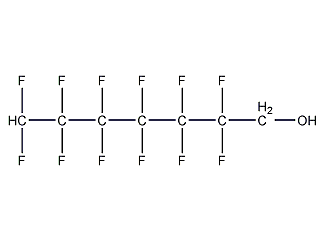
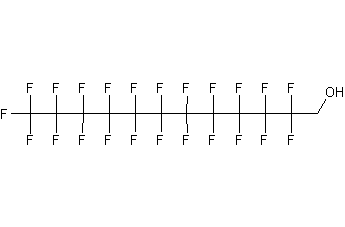
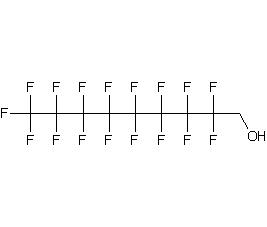
1h,1h,5h-otafluoropentyl-acrylate
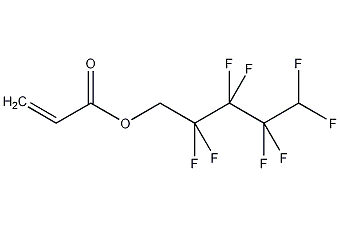
1H,1H,5H-octafluoropentyl-acrylate structural formula

1h,1h,5h-octafluoropentyl-acrylate structural formula

structural formula

business number 04kt
molecular formula c8h6f8o2
molecular weight 286.12
label

octafluoropentyl acrylate,

h2c=chco2ch2(cf2)3chf2,

aliphatic compounds

numbering system

cas number:376-84-1

mdl number:mfcd00039279

einecs number:206-816-5

rtecs number:none

brn number:none

pubchem number:24871001

physical property data

一 , physical property data

traits :not available

density (g/ml,25/4): 1.488

relative vapor density (g/ml, air=1)not available

melting point (ºc): not available

boiling point (ºc, normal pressure): 122

boiling point (ºc, 5.2kpa): not available

refraction rate: 1.349

flash point (ºc): not available

optical rotation (º): not available

spontaneous combustion point or ignition temperature (ºc): not available

steam pressure (kpa, 25ºc): not available

saturated vapor pressure (kpa, 60ºc): not available

burn heat (kj/mol):not available

critical temperature (ºc): not available

critical pressure (kpa): not available

oil and water log value of the (octanol/water) partition coefficient:not available

explosion upper limit (%, v/v): not available

explosion lower limit (%, v/v): not available

dissolve properties: not available

toxicological data

two , toxicological data:

acute toxicity:not available .

ecological data

three , ecological data:

1 ,other harmful effects: this substance may be harmful to the environment, and special treatment should be given to water bodies. notice.

molecular structure data

1. molar refractive index: 41.77

2. molar volume (m3/mol):203.2

3. isotonic specific volume (90.2k):422.8

4. surface tension (dyne/cm):18.7

5, polarizability10-24cm3):16.56

compute chemical data

1. reference value for hydrophobic parameter calculation (xlogp): 3.6

2. number of hydrogen bond donors: 0

3. number of hydrogen bond acceptors: 10

4. number of rotatable chemical bonds: 7

5. number of tautomers: none

6. topological molecule polar surface area 26.3

7. number of heavy atoms: 18

8. surface charge: 0

9. complexity: 325

10. number of isotope atoms: 0

11. determine the number of atomic stereocenters: 0

12. uncertain number of atomic stereocenters: 0

13. determine the number of chemical bond stereocenters: 0

14. number of uncertain chemical bond stereocenters: 0

15. number of covalent bond units: 1

properties and stability

none

storage method

none

synthesis method

none

purpose

none
resource:allhdi.com

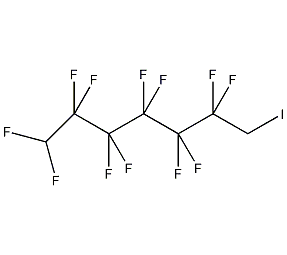
1h,1h,7h-iododedecafluoroheptyl ester

1H,1H,7H-iododecafluoroheptyl ester structural formula

1h,1h,7h-iododecafluoroheptyl ester structural formula

structural formula

business number 04kn
molecular formula c7h3f12i
molecular weight 441.99
label

1h,1h,7h-iododedecafluoroheptyl ester,

1h,1h,7h-iodoperfluoroheptane,

aliphatic compounds

numbering system

cas number:376-32-9

mdl number:none

einecs number:none

rtecs number:none

brn number:none

pubchem id:none

physical property data

一 , physical property data

traits :not available

density (g/ml,25/4): 2.044

relative vapor density (g/ml, air=1)not available

melting point (ºc): not available

boiling point (ºc, normal pressure): 78

boiling point (ºc, 5.2kpa): not available

refraction rate: 1.364

flash point (ºc): not available

optical rotation (º): not available

spontaneous combustion point or ignition temperature (ºc): not available

steam pressure (kpa, 25ºc): not available

saturated vapor pressure (kpa, 60ºc): not available

burn heat (kj/mol):not available

critical temperature (ºc): not available

critical pressure (kpa): not available

oil and water log value of the (octanol/water) partition coefficient:not available

explosion upper limit (%, v/v): not available

explosion lower limit (%, v/v): not available

dissolve properties: not available

toxicological data

two , toxicological data:

acute toxicity:not available .

ecological data

three , ecological data:

1 ,other harmful effects: this substance may be harmful to the environment, and special treatment should be given to water bodies. notice.

molecular structure data

1. molar refractive index: 49.20

2. molar volume (m3/mol):228.8

3. isotonic specific volume (90.2k):471.5

4. surface tension (dyne/cm):18.0

5, polarizability10-24cm3):19.50

compute chemical data

1. reference value for hydrophobic parameter calculation (xlogp): 5.5

2. number of hydrogen bond donors: 0

3. number of hydrogen bond acceptors: 12

4. number of rotatable chemical bonds: 6

5. number of tautomers: none

6. topological molecule polar surface area 0

7. number of heavy atoms: 20

8. surface charge: 0

9. complexity: 348

10. number of isotope atoms: 0

11. determine the number of atomic stereocenters: 0

12. uncertain number of atomic stereocenters: 0

13. determine the number of chemical bond stereocenters: 0

14. number of uncertain chemical bond stereocenters: 0

15. number of covalent bond units: 1

properties and stability

none yet

storage method

none yet

synthesis method

none yet

purpose

none yet

resource:allhdi.com

1h,1h,9h-hexafluorononanol

1H,1H,9H-Hexafluorononanol structural formula

1h,1h,9h-hexafluorononanol structural formula

structural formula

business number 04kl
molecular formula c9h4f16o
molecular weight 432.11
label

2,2,3,3,4,4,5,5,6,6,7,7,8,8,9,9-hexabromofluoronon-1-ol,

2,2,3,3,4,4,5,5,6,6,7,7,8,8,9,9-hexabromofluoronon-1-nonanol,

2,2,3,3,4,4,5,5,6,6,7,7,8,8,9,9-hexadecafluorononan-1-ol,

2,2,3,3,4,4,5,5,6,6,7,7,8,8,9,9-hexadecafluoro-1-nonanol,

h(cf2)8ch2oh,

aliphatic compounds

numbering system

cas number:376-18-1

mdl number:mfcd00039629

einecs number:206-806-0

rtecs number:ra7905000

brn number:1808149

pubchem id:none

physical property data

一 , physical property data

traits :not available

density (g/ml,25/4): not available

relative vapor density (g/ml, air=1)not available

melting point (ºc): 53-59

boiling point (ºc, normal pressure): 155-156

boiling point (ºc, 5.2kpa): not available

refraction rate: not available

flash point (ºc): 157-158

optical rotation (º): not available

spontaneous combustion point or ignition temperature (ºc): not available

steam pressure (kpa, 25ºc): not available

saturated vapor pressure (kpa, 60ºc): not available

burn heat (kj/mol):not available

critical temperature (ºc): not available

critical pressure (kpa): not available

oil and water log value of the (octanol/water) partition coefficient:not available

explosion upper limit (%, v/v): not available

explosion lower limit (%, v/v): not available

dissolve properties: not available

toxicological data

2. toxicological data:

acute toxicity:not available .

ecological data

three , ecological data:

1 , other harmful effects: this substance may be harmful to the environment, and special treatment should be given to water bodies. notice.

molecular structure data

1. molar refractive index: 47.61

2. molar volume (m3/mol):262.4

3. isotonic specific volume (90.2k):522.1

4. surface tension (dyne/cm):15.6

5. polarizability10-24cm3):18.87

compute chemical data

1. reference value for hydrophobic parameter calculation (xlogp): 5.1

2. number of hydrogen bond donors: 1

3. number of hydrogen bond acceptors: 17

4. number of rotatable chemical bonds: 8

5. number of tautomers: none

6. topological molecule polar surface area 20.2

7. number of heavy atoms: 26

8. surface charge: 0

9. complexity: 508

10. number of isotope atoms: 0

11. determine the number of atomic stereocenters: 0

12. uncertain number of atomic stereocenters: 0

13. determine the number of chemical bond stereocenters: 0

14. number of uncertain chemical bond stereocenters: 0

15. number of covalent bond units: 1

properties and stability

none yet

storage method

none yet

synthesis method

none yet

purpose

none yet

resource:allhdi.com

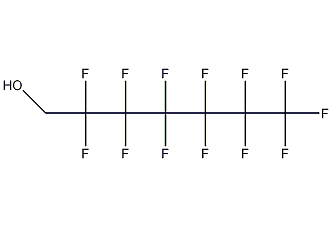
1h,1h-perfluoro-1-heptanol

1H,1H-Perfluoro-1-heptanol structural formula

1h,1h-perfluoro-1-heptanol structural formula

structural formula

business number 04kc
molecular formula c7h3f13o
molecular weight 350.08
label

aliphatic compounds

numbering system

cas number:375-82-6

mdl number:none

einecs number:206-796-8

rtecs number:none

brn number:none

pubchem id:none

physical property data

一 , physical property data

traits :not available

density (g/ml,25/4): 1.75

relative vapor density (g/ml, air=1)not available

melting point (ºc): not available

boiling point (ºc, normal pressure): 147

boiling point (ºc, 5.2kpa): not available

refractive index: not available

flash point (ºc): not available

optical rotation (º): not available

spontaneous combustion point or ignition temperature (ºc): not available

steam pressure (kpa, 25ºc): not available

saturated vapor pressure (kpa, 60ºc): not available

burn heat (kj/mol):not available

critical temperature (ºc): not available

critical pressure (kpa): not available

oil and water log value of the (octanol/water) partition coefficient:not available

explosion upper limit (%, v/v): not available

explosion lower limit (%, v/v): not available

dissolve properties: not available

toxicological data

two , toxicological data:

acute toxicity:not available .

ecological data

three , ecological data:

1 , other harmful effects: this substance may be harmful to the environment, and special treatment should be given to water bodies. notice.

molecular structure data

1. molar refractive index: 37.93

2. molar volume (m3/mol):212.6

3. isotonic specific volume (90.2k):421.5

4. surface tension (dyne/cm):15.4

5. polarizability10-24cm3):15.03

compute chemical data

1. reference value for hydrophobic parameter calculation (xlogp): none

2. number of hydrogen bond donors: 1

3. number of hydrogen bond acceptors: 14

4. number of rotatable chemical bonds: 5

5. number of tautomers: none

6. topological molecule polar surface area 20.2

7. number of heavy atoms: 21

8. surface charge: 0

9. complexity: 381

10. number of isotope atoms: 0

11. determine the number of atomic stereocenters: 0

12. uncertain number of atomic stereocenters: 0

13. determine the number of chemical bond stereocenters: 0

14. number of uncertain chemical bond stereocenters: 0

15. number of covalent bond units: 1

properties and stability

none yet

storage method

none yet

synthesis method

none yet

purpose

none yet

resource:allhdi.com

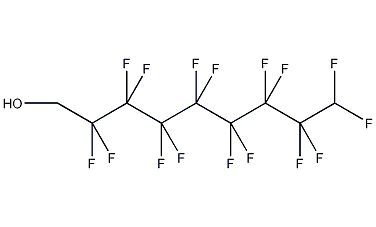
1h,1h,7h-dodecafluoro-1-heptanol

1H,1H,7H-Dodecafluoro-1-heptanol structural formula

1h,1h,7h-dodecafluoro-1-heptanol structural formula

structural formula

business number 04a9
molecular formula c7h2f12o
molecular weight 332.09
label

dodecafluoroheptanol,

1h,1h,7h-dodecafluoro-1-heptanol,

7h 6:1 ftoh,

1h,1h,7h-perfluoro-1-heptanol,

1h,1h,7h-dodecafluoro-1-heptanol,

1h,1h,7h-dodecafluorofluoroheptanol-1,

1h,1h,7h-dodecafluoroheptan-1-ol,

1h,1h,7h-dodecafluoroheptanol,

1h,1h,7h-perfluoroheptan-1-ol,

1,1,7-trihydroperfluoroheptanol

numbering system

cas number:335-99-9

mdl number:mfcd00039630

einecs number:206-406-6

rtecs number:mj4500000

brn number:1800110

pubchem id:none

physical property data

一 , physical property data

traits :not available

density (g/ml,25/4): 1.76

relative vapor density (g/ml, air=1)not available

melting point (ºc): -20

boiling point (ºc, normal pressure):169-170

boiling point (ºc, 5.2kpa): not available

refraction rate: 1316-1.318

flash point (ºc): not available

optical rotation (º): not available

spontaneous combustion point or ignition temperature (ºc): not available

steam pressure (kpa, 25ºc): not available

saturated vapor pressure (kpa, 60ºc): not available

burn heat (kj/mol):not available

critical temperature (ºc): not available

critical pressure (kpa): not available

oil and water log value of the (octanol/water) partition coefficient:not available

explosion upper limit (%, v/v): not available

explosion lower limit (%, v/v): not available

dissolve properties: not available

toxicological data

two , toxicological data:

acute toxicity:not available .

ecological data

three , ecological data:

1 , other harmful effects: this substance may be harmful to the environment, and special treatment should be given to water bodies. notice.

molecular structure data

1. molar refractive index: 37.76

2. molar volume (m3/mol):207.5

3. isotonic specific volume (90.2k):414.3

4. surface tension (dyne/cm):15.8

5. polarizability10-24cm3):14.97

compute chemical data

1. reference value for hydrophobic parameter calculation (xlogp): 3.8

2. number of hydrogen bond donors: 1

3. number of hydrogen bond acceptors: 13

4. number of rotatable chemical bonds: 6

5. number of tautomers: none

6. topological molecule polar surface area 20.2

7. number of heavy atoms: 20

8. surface charge: 0

9. complexity: 348

10. number of isotope atoms: 0

11. determine the number of atomic stereocenters: 0

12. uncertain number of atomic stereocenters: 0

13. determine the number of chemical bond stereocenters: 0

14. number of uncertain chemical bond stereocenters: 0

15. number of covalent bond units: 1

properties and stability

none

storage method

none

synthesis method

none

purpose

none
resource:allhdi.com

1h,1h-perfluoro-1-dodecanol

1H,1H-Perfluoro-1-dodecanol structural formula

1h,1h-perfluoro-1-dodecanol structural formula

structural formula

business number 04sb
molecular formula c12h3of23
molecular weight 600.12
label

1h,1h-perfluoro-1-dodecyl alcohol,

1h,1h-perfluoro-1-dodecyl alcohol, tech,

1h,1h-perfluorododecan-1-ol,

1h,1h-perfluorododecanol,

1h,1h-perfluoro-1-dodecanol,

perfluorododecanol,

1h,1h-perfluoro-1-dodecanol 96%,

1h,1h-perfluorododecan-1-ol 96%,

1h,1h-perfluorododecan-1-ol96%,

1h,1h-perfluoro-1-dodecanol: tech., 90%

numbering system

cas number:423-65-4

mdl number:mfcd00153235

einecs number:000-000-0

rtecs number:none

brn number:1810966

pubchem id:none

physical property data

一 , physical property data

traits :not available

density (g/ml,25/4): not available

relative vapor density (g/ml, air=1)not available

melting point (ºc): 111-113

boiling point (ºc, normal pressure):224
boiling point (ºc, 5.2kpa): not available

refraction rate: not available

flash point (ºc): 224

optical rotation (º): not available

spontaneous combustion point or ignition temperature (ºc): not available

steam pressure (kpa, 25ºc): not available

saturated vapor pressure (kpa, 60ºc): not available

burn heat (kj/mol):not available

critical temperature (ºc): not available

critical pressure (kpa): not available

oil and water log value of the (octanol/water) partition coefficient:not available

explosion upper limit (%, v/v): not available

explosion lower limit (%, v/v): not available

dissolve sex: not available

toxicological data

two , toxicological data:

acute toxicity:not available .

ecological data

three , ecological data:

1 ,other harmful effects: this substance may be harmful to the environment, and special treatment should be given to water bodies. notice.

molecular structure data

1 molar refractive index:62.56

2 molar volumem3/mol)349.9

3 isotonic specific volume (90.2k): 691.0

4 surface tensiondyne/cm)15.2

5 polarizability(10-24cm324.80

compute chemical data

1. reference value for hydrophobic parameter calculation (xlogp): none

2. number of hydrogen bond donors: 1

3. number of hydrogen bond acceptors: 24

4. number of rotatable chemical bonds: 10

5. number of tautomers: none

6. topological molecule polar surface area 20.2

7. number of heavy atoms: 36

8. surface charge: 0

9. complexity: 802

10. number of isotope atoms: 0

11. determine the number of atomic stereocenters: 0

12. uncertain number of atomic stereocenters: 0

13. determine the number of chemical bond stereocenters: 0

14. number of uncertain chemical bond stereocenters: 0

15. number of covalent bond units: 1

properties and stability

none

storage method

none

synthesis method

none

purpose

none
the unique contribution of uv absorber uv-p in cosmetic formulas

uv absorber uv-p: invisible guardian in cosmetic formula

in today’s era of pursuing beauty, cosmetics have long become a necessity in people’s daily lives. from foundation to sunscreen, from eye sha to lipstick, behind each product is a complex formula designed by scientists. among these many ingredients, there is a low-key but crucial existence-the ultraviolet absorber uv-p (2-phenylbenzimidazole-5-sulfonic acid). it is like an unknown hero behind the scenes, building a solid barrier for the skin to resist uv rays where we cannot see it.

what is uv absorber uv-p?

uv absorber uv-p is a highly efficient, broad-spectrum chemical sunscreen with a chemical name of 2-phenylbenzimidazole-5-sulfonic acid (phenylbenzimidazole sulfonic acid, referred to as pbsa or uv-p for short). as a water-soluble sunscreen, uv-p is known for its excellent uv absorption capability and can effectively protect against uv radiation in the uva and uvb bands. its molecular structure is unique, including benzimidazole rings and sulfonic acid groups, which makes it not only have strong uv absorption properties, but also has good light stability and safety.

uv-p was first developed by a german company and was applied to the cosmetics field in the 1970s. with its outstanding performance, uv-p has quickly become one of the widely used sunscreen active ingredients worldwide. at present, it has been included in the authoritative regulatory systems such as the eu, the us fda and china’s “catalogue of used cosmetics raw materials” and has become one of the core components of sunscreen product formula design.

basic characteristics of uv-p

in order to better understand the mechanism of action of uv-p in cosmetics, we need to first understand its basic physicochemical properties:

parameter name data value remarks
chemical formula c14h10n2o3s
molecular weight 294.3 g/mol
solution easy soluble in water, slightly soluble in
melting point >300°c decomposition temperature
ph range 5.0-7.0 recommended usage conditions

these parameters show that uv-p is a highly stable compound that can maintain activity over a wide ph range while having good water solubility, making it easy to mix with other cosmetic ingredients to form a uniform and stable formula system.

uv-p’s unique contribution: why is it a star ingredient in cosmetic formulas?

in the field of sun protection cosmetics, uv-p is popular mainly because it has the following unique advantages:

  1. broad spectrum protection: uv-p can absorb ultraviolet rays in the uva and uvb bands at the same time, providing a comprehensive ultraviolet protection effect. compared to some sunscreens that only target a single band, the broad spectrum properties of uv-p make it ideal for sunscreen formulations.

  2. high stability: uv-p has excellent light stability and is not easy to decompose and fail under sunlight, ensuring long-term and effective sun protection. in addition, it can synergize with other sunscreens to further improve the overall sunscreen effect.

  3. low irritation: as a long-proven safety ingredient, uv-p has extremely low irritation to the skin and is suitable for all skin types, including people with sensitive skin. this makes it one of the core ingredients of many high-end sunscreen products.

  4. water solubility advantages: since uv-p itself is water-soluble, it can be easily incorporated into lotions, gels and even spray-type sunscreen products, giving the product a better user experience. at the same time, this characteristic also facilitates the adjustment of product texture by adding thickeners and other methods to meet the needs of different consumers.

  5. environmentally friendly: compared with certain oil-soluble sunscreens, uv-p is considered to have a smaller potential impact on marine ecosystems due to its low bioaccumulativeness and degradability, which is in line with the current trend of green and environmental protection.

to sum up, uv absorber uv-p has become an indispensable key ingredient in modern sunscreen cosmetics with its excellent performance. next, we will explore the specific application of uv-p in cosmetic formulas and the scientific principles behind it.


the mechanism of action of uv-p: how to block ultraviolet rays?

to understand the actual effects of uv-p in cosmetics, we first need to understand the harm of ultraviolet rays to human skin and how uv-p plays its sun protection role.

the hazards of ultraviolet rays: not onlyit’s as simple as tanning

ultraviolet rays can be divided into three main bands according to their wavelength: uva (320-400nm), uvb (290-320nm) and uvc (<290nm). among them, uvc is almost completely absorbed by the atmosphere and has little impact on our daily lives; while uva and uvb are the main culprits of skin damage.

  • uva: it has strong penetration and can penetrate deep into the dermis, causing skin aging, pigmentation and other problems, commonly known as “sunny”.
  • uvb: high energy, mainly acts on the epidermis, causing acute reactions such as redness, swelling, burns, etc., which are the so-called “sunburn”.

long-term exposure to ultraviolet light will not only cause the skin to look worse, but may also increase the risk of skin cancer. therefore, choosing the right sunscreen product is crucial.

the working principle of uv-p: “light absorption war” at the molecular level

uv-p, as a chemical sunscreen, acts by absorbing the energy of ultraviolet rays and converting them into heat energy to release them, thereby avoiding the direct effect of ultraviolet rays on skin tissue. specifically, when ultraviolet rays irradiate on sunscreen products containing uv-p, the benzimidazole ring in the uv-p molecule absorbs ultraviolet photons of a specific wavelength and enters the excited state. subsequently, the energy in this excited state is dissipated in a non-radiative form (such as thermal energy) and finally returns to the ground state, completing a “ultraviolet capture” process.

this process can be expressed by simple chemical equations:

[
text{uv-p (ground state)} + hnu rightarrow text{uv-p (excited state)}
]

[
text{uv-p (excited state)} rightarrow text{uv-p (ground state)} + text{heat}
]

it is worth noting that uv-p does not undergo permanent chemical changes throughout the process, so it can repeatedly absorb ultraviolet rays and provide a lasting protection effect.

absorption spectrum analysis of uv-p

to visually demonstrate the absorption characteristics of uv-p, we can refer to its ultraviolet absorption curve:

wavelength range (nm) absorption strength (relative value) main protection objects
280-320 high uvb
320-400 in uva

from the above table, it can be seen that uv-p has higher absorption efficiency for uvb, but it also covers some uva bands, showing its broad-spectrum protection characteristics.


practical application of uv-p in cosmetic formula

in actual formula design, uv-p is usually used in conjunction with other sunscreens to achieve optimal protective effects. the following are several common uv-p applications and their characteristics:

1. use alone: ​​a simple and efficient entry-level solution

for basic sunscreen products, uv-p can be added as an active ingredient alone, suitable for brands that pursue cost-effectiveness. for example, a transparent sunscreen spray uses a pure aqueous system, dissolves uv-p in deionized water, supplemented with a small amount of thickener and moisturizer, to achieve a light and breathable experience.

2. combination and use: multi-dimensional optimization of protection performance

to further enhance the sun protection effect, uv-p is often combined with oil-soluble sunscreens (such as avobenzone, octooxybenzone) or physical sunscreens (such as titanium dioxide, zinc oxide). this combination not only broadens the absorption band, but also improves the product’s water resistance and comfort. for example, a high-end sunscreen lotion formula is as follows:

ingredient category specific ingredients function
main sunscreen uv-p absorb uva/uvb
auxiliary sunscreen avobenzone enhanced uvb absorption
physical masking agent titanium dioxide reflected uv rays
thickener karpom improving stability
moisturizer glycerin providing moisturizing

3. innovative application: exploring new sun protection technologies

with the advancement of technology, the application of uv-p is also constantly expanding. in recent years, researchers have tried to encapsulate uv-p in nanocarriers to improve its dispersion and stability. this approach not only reduces the amount of uv-p used in the formula, but also reduces its potential irritation risk to the skin. in addition, combined with smart responsive materials (such as ph-sensitive polymers), can also realize the on-demand release function, further improving the sun protection effect.


progress in domestic and foreign research: new trends in uv-p

the research on uv-p is always active, and the following are several representative results:

  1. improving photo stability: a german research team found that introducing additional electron donor groups into uv-p molecules can significantly improve their light stability and extend the effective time of sunscreen products.

  2. environmental impact assessment: japanese scientists have shown through research on coral reef ecosystems that uv-p is less toxic to marine organisms and is more environmentally friendly than some traditional oil-soluble sunscreens.

  3. new combination strategy: a cosmetics company in the united states has developed a composite sun protection system based on uv-p and plant extracts, which not only retains the strong protection ability of uv-p, but also adds antioxidant and repair functions.


conclusion: future outlook of uv-p

as an important member of the cosmetics field, uv-p, the ultraviolet absorber, has won wide recognition in the global market due to its advantages such as broad spectrum protection, high stability and low irritation. however, as consumers’ requirements for safety and environmental protection are increasing, uv-p research and development still needs to be continuously innovated and improved. we have reason to believe that in the near future, this “invisible guardian” will continue to bring a more excellent sun protection experience to mankind!

extended reading:https://www.cyclohexylamine.net/dabco-mp608-delayed-equilibrium-catalyst/

extended reading:https://www.bdmaee.net/wp-content/uploads/2022/08/-ne500-non-emission-amine-catalyst-ne500-strong-gel-amine-catalyst-ne500.pdf

extended reading:https://www.newtopchem.com/archives/category/products/page/108

extended reading:https://www.bdmaee.net/cas-1067-33-0-2/

extended reading:https://www.newtopchem.com/archives/44625

extended reading:https://www.bdmaee.net/wp-content/uploads/2021/05/2-7.jpg

extended reading:https://www.newtopchem.com/archives/category/products/page/143

extended reading:https://www.newtopchem.com/archives/40491

extended reading:https://www.bdmaee.net/wp-content/uploads/2022/08/31-15.jpg

extended reading:https://www.newtopchem.com/archives/767

bdmaee:bis (2-dimethylaminoethyl) ether

cas no:3033-62-3

china supplier

for more information, please contact the following email:

email:sales@newtopchem.com

email:service@newtopchem.com

email:technical@newtopchem.com

BDMAEE Manufacture !