5,5-biphenyl hydantoin
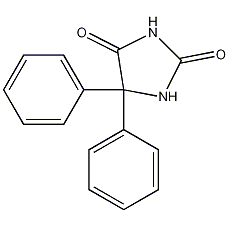
5,5-biphenylhydantoin structural formula

structural formula

business number 018l
molecular formula c15h12n2o2
molecular weight 252.27
label

phenytoin,

5,5-diphenyl-2,4-imidazolidinedione,

phenytoin

numbering system

cas number:57-41-0

mdl number:mfcd00005264

einecs number:200-328-6

rtecs number:mu1050000

brn number:384532

pubchem number:24278370

physical property data

none

toxicological data

none

ecological data

none

molecular structure data

1. molar refractive index: 69.58

2. molar volume (cm3/mol): 200.5

3. isotonic specific volume (90.2k ): 531.3

4. surface tension (dyne/cm): 49.2

5. polarizability (10-24cm3): 27.58

compute chemical data

1. reference value for hydrophobic parameter calculation (xlogp): none

2. number of hydrogen bond donors: 2

3. number of hydrogen bond acceptors: 2

4. number of rotatable chemical bonds: 2

5. number of tautomers: 5

6. topological molecule polar surface area 58.2

7. number of heavy atoms: 19

8. surface charge: 0

9. complexity: 350

10. number of isotope atoms: 0

11. determine the number of atomic stereocenters: 0

12. uncertain number of atomic stereocenters: 0

13. determine the number of chemical bond stereocenters: 0

14. number of uncertain chemical bond stereocenters: 0

15. number of covalent bond units: 1

properties and stability

none

storage method

this product should be sealed and stored away from light.

synthesis method

none

purpose

organic synthesis. antiepileptic, anticonvulsant drugs. ​

extended-reading:https://www.morpholine.org/dabco-amine-catalyst-low-density-sponge-catalyst/
extended-reading:https://www.cyclohexylamine.net/delayed-catalyst-1028-delayed-catalyst/
extended-reading:https://www.bdmaee.net/dabco-t-catalyst-cas10294-43-5–germany/
extended-reading:https://www.bdmaee.net/high-rebound-retardation-catalyst/
extended-reading:https://www.bdmaee.net/polyurethane-retardation-catalyst-c-225/
extended-reading:https://www.bdmaee.net/dimorpholinyl-diethyl-ether-cas-6425-39-4-22-bismorpholinyl-diethyl-ether/
extended-reading:https://www.bdmaee.net/nt-cat-bdma-catalyst-cas103-83-3-newtopchem/
extended-reading:https://www.bdmaee.net/nt-cat-16-catalyst-cas280-57-9-newtopchem/
extended-reading:https://www.morpholine.org/4-formylmorpholine/
extended-reading:https://www.newtopchem.com/archives/category/products/page/106
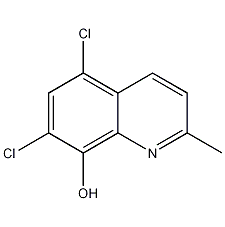
5,7-dichloro-2-methyl-8-hydroxyquinoline

5,7-dichloro-2-methyl-8-hydroxyquinoline structural formula

structural formula

business number 01h9
molecular formula c10h7cl2no
molecular weight 228.07
label

chloroquinadol,

5,7-dichloro-2-methyl-8-hydroxyquinoline,

5,7-dichloro-8-hydroxyquinaldine,

5,7-dichloro-2-methyl-8-hydroxyquinoline,

5,7-dichloro-8-quinaldol,

5,7-dichloro-2-methyl-8-quinolinol,

hydroxydichloroquinaldine,

bcm

numbering system

cas number:72-80-0

mdl number:mfcd00023984

einecs number:200-789-3

rtecs number:vc5600000

brn number:156683

pubchem number:24893930

physical property data

1. character: uncertain

2. density (g/ml,25/4): unsure

3. relative vapor density (g/ml,air=1): unsure

4. melting point (ºc):108-112 (dec.)(lit.)

5. boiling point (ºc,normal pressure): unsure

6. boiling point (ºc, 5.2 kpa): unsure

7. refractive index:not sure

8. flash point (ºc): unsure

9. specific optical rotation (º): unsure

10. autoignition point or ignition temperature (ºc): unsure

11. vapor pressure (kpa,25 ºc): unsure

12. saturated vapor pressure (kpa,60 ºc): unsure

13. heat of combustion (kj/mol): unsure

14. critical temperature (ºc): unsure

15. critical pressure (kpa): unsure

16. oil and water (octanol/log value of water) partition coefficient: uncertain

17. explosion limit (%,v/v): unsure

18. lower explosion limit (%,v/v): unsure

19. solubility:insoluble in water

toxicological data

acute toxicity: rat oral administration ld50: 660 mg/kg; dog oral administration ld50: 2250 mg/kg;rabbit oral ld50160 mg/kg;
mutagenic:aspergillus nidulanssex chromosome nondisjunction loss and testing system 1 gm/l;

ecological data

none

molecular structure data

5. molecular property data:

1. molar refractive index: 58.68

2. molar volume (m3/mol):155.3

3. isotonic specific volume (90.2k):429.6

4. surface tension (dyne/cm):58.4

5. polarizability10-24cm3):23.26

compute chemical data

1. reference value for hydrophobic parameter calculation (xlogp): 3.5

2. number of hydrogen bond donors: 1

3. number of hydrogen bond acceptors: 2

4. number of rotatable chemical bonds: 0

5. number of tautomers: 2

6. topological molecule polar surface area 33.1

7. number of heavy atoms: 14

8. surface charge: 0

9. complexity: 214

10. number of isotope atoms: 0

11. determine the number of atomic stereocenters: 0

12. uncertain number of atomic stereocenters: 0

13. determine the number of chemical bond stereocenters: 0

14. number of uncertain chemical bond stereocenters: 0

15. number of covalent bond units: 1

properties and stability

none

storage method

none

synthesis method

none

purpose

none

extended-reading:https://www.cyclohexylamine.net/balance-catalyst-ne210-dabco-amine-catalyst/
extended-reading:https://www.cyclohexylamine.net/non-emission-amine-catalyst-non-emission-delayed-amine-catalyst/
extended-reading:https://www.morpholine.org/dabco-33-s-microporous-catalyst/
extended-reading:https://www.bdmaee.net/toyocat-dt-strong-foaming-catalyst-pentamethyldiethylenetriamine-/
extended-reading:https://www.bdmaee.net/dimethyltin-dioctanoate/
extended-reading:https://www.bdmaee.net/low-odor-reaction-type-9727-catalyst-9727-reaction-type-catalyst-9727/
extended-reading:https://www.cyclohexylamine.net/spraying-catalyst-composite-amine-catalyst/
extended-reading:https://www.cyclohexylamine.net/dimethyltin-oxide-cas-2273-45-2/
extended-reading:https://www.newtopchem.com/archives/category/products/adhesive-catalyst
extended-reading:https://www.newtopchem.com/archives/1112

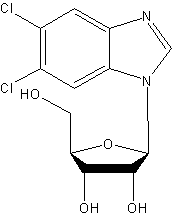
5,6-dichloro-1-β-d-ribofuranosylbenzimidazole

5,6-dichloro-1-β-d-ribofuranosylbenzimidazole structural formula

structural formula

business number 0163
molecular formula c12h12cl2n2o4
molecular weight 319.14
label

dichlorobenzimidazole furanoside,

5,6-dichloro-1-β-d-ribofuranosylbenzimidazole,

5,6-dichlorobenzimidazole riboside,

drb

numbering system

cas number:53-85-0

mdl number:mfcd00036785

einecs number:none

rtecs number:dd7310000

brn number:39123

pubchem number:24278361

physical property data

none

toxicological data

1, mutagenicity : mutation test system and not other specifiedtest systems: insects, and not cells otherwise specified not otherwise specified: 65umol/l;
mutation testing system and not other specifiedtest systems: human hela cells: 40umol/l

ecological data

none

molecular structure data

1. molar refractive index: 70.35

2. molar volume (m3/mol):172.7

3. isotonic ratio(90.2k)501.0

4. surface tension(dyne/cm)70.7

5. polarizability(10-24cm3)27.89

compute chemical data

1. reference value for hydrophobic parameter calculation (xlogp):1.1

2. number of hydrogen bond donors: 3

3. number of hydrogen bond acceptors: 5

4. number of rotatable chemical bonds: 2

5. number of tautomers:

6. topological molecular polar surface area (tpsa):87.7

7. number of heavy atoms: 20

8. surface charge: 0

9. complexity: 364

10. number of isotope atoms: 0

11. determine the number of atomic stereocenters: 4

12. the number of uncertain atomic stereocenters: 0

13. determine the number of stereocenters of chemical bonds: 0

14. uncertain number of chemical bond stereocenters: 0

15. number of covalent bond units: 1

properties and stability

none

storage method

none

synthesis method

none

purpose

none

extended-reading:https://www.newtopchem.com/archives/40247
extended-reading:https://www.cyclohexylamine.net/dabco-bl-11-niax-a-1-jeffcat-zf-22/
extended-reading:https://www.bdmaee.net/wp-content/uploads/2022/08/di-n-butyl-tin-diisooctoate-cas2781-10-4-fascat4208-catalyst.pdf
extended-reading:https://www.newtopchem.com/archives/39408
extended-reading:https://www.cyclohexylamine.net/pc-cat-ncm-polyester-sponge-catalyst-dabco-ncm/
extended-reading:https://www.newtopchem.com/archives/1856
extended-reading:https://www.cyclohexylamine.net/dabco-pt302-low-odor-tertiary-amine-catalyst/
extended-reading:https://www.newtopchem.com/archives/44166
extended-reading:https://www.newtopchem.com/archives/44024
extended-reading:https://www.bdmaee.net/wp-content/uploads/2022/08/38-3.jpg

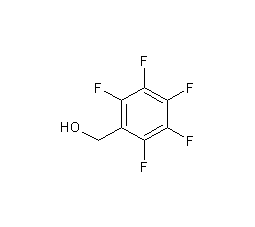
2,3,4,5,6-pentafluorobenzyl alcohol

2,3,4,5,6-pentafluorobenzyl alcohol structural formula

2,3,4,5,6-pentafluorobenzyl alcohol structural formula

structural formula

business number 04u0
molecular formula c7h3f5o
molecular weight 198
label

none yet

numbering system

cas number:440-60-8

mdl number:mfcd00004602

einecs number:207-126-7

rtecs number:dp0695000

brn number:2052669

pubchem number:24851790

physical property data

一 , physical property data

traits :white solid

density (g/ml,25/4): not available

relative vapor density (g/ml, air=1)not available

melting point (ºc): 37-38

boiling point (ºc, normal pressure): 114-115

boiling point (ºc, 5.2kpa): not available

refraction rate: not available

flash point (ºc): 87

optical rotation (º): not available

spontaneous combustion point or ignition temperature (ºc): not available

steam pressure (kpa, 25ºc): not available

saturated vapor pressure (kpa, 60ºc): not available

burn heat (kj/mol):not available

critical temperature (ºc): not available

critical pressure (kpa): not available

oil and water log value of the (octanol/water) partition coefficient:not available

explosion upper limit (%, v/v): not available

explosion lower limit (%, v/v): not available

dissolve properties: not available

toxicological data

two , toxicological data:

acute toxicity:not available .

ecological data

three , ecological data:

1 ,other harmful effects: this substance may be harmful to the environment, and special treatment should be given to water bodies. notice.

molecular structure data

1 molar refractive index:32.67

2 molar volumem3/mol)124.2

3 isotonic specific volume (90.2k):296.4

4 surface tensiondyne/cm)32.3

5 polarizability(10-24cm312.95

compute chemical data

1. reference value for hydrophobic parameter calculation (xlogp): 1.5

2. number of hydrogen bond donors: 1

3. number of hydrogen bond acceptors: 6

4. number of rotatable chemical bonds: 1

5. number of tautomers: none

6. topological molecule polar surface area 20.2

7. number of heavy atoms: 13

8. surface charge: 0

9. complexity: 162

10. number of isotope atoms: 0

11. determine the number of atomic stereocenters: 0

12. uncertain number of atomic stereocenters: 0

13. determine the number of chemical bond stereocenters: 0

14. number of uncertain chemical bond stereocenters: 0

15. number of covalent bond units: 1

properties and stability

none yet

storage method

none yet

synthesis method

the preparation method is 2,3,4,5,6-pentafluorobenzoic acid on a zn electrode in 5% h2 the product is obtained by fluidized bed electrolysis in so4 solution.

purpose

intermediates for pharmaceuticals, pesticides, and liquid crystal materials.

resource:allhdi.com

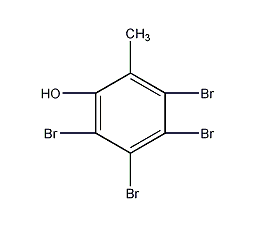
3,4,5,6-tetrabromo-o-cresol

3,4,5,6-tetrabromo-o-cresol structural formula

3,4,5,6-tetrabromo-o-cresol structural formula

structural formula

business number 05v7
molecular formula c7h4br4o
molecular weight 423.72
label

2,3,4,5-tetrabromo-6-methyl-pheno,

aromatic compounds

numbering system

cas number:576-55-6

mdl number:mfcd00002148

einecs number:209-403-8

rtecs number:gp3135000

brn number:none

pubchem number:24856732

physical property data

1. physical property data

1. melting point (ºc): 209-213

toxicological data

none

ecological data

none

molecular structure data

5. molecular property data:

1. molar refractive index:63.72

2. molar volume (m3/mol):168.8

3. isotonic specific volume (90.2k):461.9

4. surface tension (dyne/cm):55.9

5. polarizability10-24cm3):25.26

compute chemical data

1. reference value for hydrophobic parameter calculation (xlogp): 4.7

2. number of hydrogen bond donors: 1

3. number of hydrogen bond acceptors: 1

4. number of rotatable chemical bonds: 0

5. number of tautomers: 3

6. topological molecule polar surface area 20.2

7. number of heavy atoms: 12

8. surface charge: 0

9. complexity: 166

10. number of isotope atoms: 0

11. determine the number of atomic stereocenters: 0

12. uncertain number of atomic stereocenters: 0

13. determine the number of chemical bond stereocenters: 0

14. number of uncertain chemical bond stereocenters: 0

15. number of covalent bond units: 1

properties and stability

none

storage method

none

synthesis method

none

purpose

none

resource:allhdi.com

5,5-dimethoxazolidine-2,4-dione

5,5-dimethoxazolidine-2,4-dione structural formula

5,5-dimethoxazolidine-2,4-dione structural formula

structural formula

business number 07ak
molecular formula c5h7no3
molecular weight 129.11
label

dimethyldione,

dimethadione,

sensitizer,

heterocyclic compounds

numbering system

cas number:695-53-4

mdl number:mfcd00005379

einecs number:211-781-4

rtecs number:rp9100000

brn number:113541

pubchem number:24894144

physical property data

1. characteristics: crystal.

2. density (g/ml,25/4): undetermined

3. relative vapor density (g/ml,air=1): undetermined

4. melting point (ºc): 77-80

5. boiling point (ºc,normal pressure): undetermined

6. boiling point (ºc,5.2kpa): undetermined

7. refractive index: undetermined

8. flash point (ºc): undetermined

9. specific optical rotation (º): undetermined

10. autoignition point or ignition temperature (ºc): undetermined

11. vapor pressure (kpa,25ºc): undetermined

12. saturated vapor pressure (kpa,60ºc): undetermined

13. heat of combustion (kj/mol): undetermined

14. critical temperature (ºc): undetermined

15. critical pressure (kpa): undetermined

16. oil and water (octanol/log value of the partition coefficient of water: undetermined

17. explosion limit (%,v/v): undetermined

18. lower explosion limit (%,v/v): undetermined

19. solubility: undetermined .

toxicological data

1, acute toxicity: mouse (peritoneal) ld50: 850 mg/kg
since the ld50 of table salt is 3,000 mg/kg, bpa is the degree of acute toxicity is the same as that of table salt.

ecological data

do not let this product come into contact with groundwater, waterways and sewage systems.

molecular structure data

1. molar refractive index: 28.37

2. molar volume(m3/mol107.2

3. isotonic ratio90.2k255.8

4. surface tensiondyne/cm32.4

5. dielectric constant:

6. dipole moment10-24cm3

7. polarizability: 11.24

compute chemical data

1. reference value for hydrophobic parameter calculation (xlogp): 0.1

2. number of hydrogen bond donors: 1

3. number of hydrogen bond acceptors: 3

4. number of rotatable chemical bonds: 0

5. number of tautomers: 3

6. topological molecule polar surface area 55.4

7. number of heavy atoms: 9

8. surface charge: 0

9. complexity: 173

10. number of isotope atoms: 0

11. determine the number of atomic stereocenters: 0

12. uncertain number of atomic stereocenters: 0

13. determine the number of chemical bond stereocenters: 0

14. number of uncertain chemical bond stereocenters: 0

15. number of covalent bond units: 1

properties and stability

keep away from oxides.

storage method

store in an airtight container and place store in a cool, dry place. store away from oxidizing agents.

synthesis method

none yet

purpose

has a wide range of uses in industry, mainly used to prepare various resins, coatings, fungicides, plasticizers and drugs. sensitizer. intracellular ofphdetermination. anticonvulsants.

resource:allhdi.com

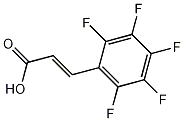
2,3,4,5,6-pentafluorocinnamic acid

2,3,4,5,6-pentafluorocinnamic acid structural formula

2,3,4,5,6-pentafluorocinnamic acid structural formula

structural formula

business number 07f5
molecular formula c9h3f5o2
molecular weight 238.11
label

pentafluorocinnamic acid,

2,3,4,5,6-pentafluorocinnamic acid,

3-(pentafluorophenyl)-2-propenoic acid,

c6f5ch=chco2h,

aromatic compounds

numbering system

cas number:719-60-8

mdl number:mfcd00004371

einecs number:none

rtecs number:none

brn number:none

pubchem number:24857472

physical property data

1. character: solid

2. density (g/ml,25/4): undetermined

3. relative vapor density (g/ml, air=1): undetermined

4. melting point (ºc):152 -156

5. boiling point (ºc,normal pressure): undetermined

6. boiling point (ºc,5.2kpa): undetermined

7. refractive index: undetermined

8. flashpoint (ºc): undetermined

9. specific optical rotation (º): undetermined

10. autoignition point or ignition temperature (ºc): undetermined

11. vapor pressure (kpa,25ºc): undetermined

12. saturated vapor pressure (kpa,60ºc)��undetermined

13. heat of combustion (kj/mol): undetermined

14. critical temperature (ºc): undetermined

15. critical pressure (kpa): undetermined

16. oil and water (octanol/log value of partition coefficient (water): undetermined

17. explosion limit (%,v/v): undetermined

18. lower explosion limit (%,v/v): undetermined

19. solubility: undetermined

toxicological data

none yet

ecological data

slightly hazardous to water. do not allow undiluted or large quantities of product to come into contact with groundwater, waterways or sewage systems. do not discharge material into the surrounding environment without government permission

molecular structure data

1. molar refractive index: 43.67

2. molar volumem3/ mol146.0

3. isotonic ratio90.2k)367.6

4. surface tension(dyne/cm)40.1

5. dielectric constant:

6. dipole moment10 -24cm3)

7. polarizability:17.31

compute chemical data

none yet

properties and stability

stable under normal temperature and pressure, avoid contact with oxides

storage method

keep container tightly sealed take it out of the container and store it in a cool, dry place

synthesis method

none yet

purpose

none yet

resource:allhdi.com

5,7-dimethoxycoumarin

5,7-dimethoxycoumarin structural formula

5,7-dimethoxycoumarin structural formula

structural formula

business number 0537
molecular formula c11h10o4
molecular weight 206.21
label

5,7-dimethoxycoumarin,

5,7-dimethoxycoumarin,

white limonin

numbering system

cas number:487-06-9

mdl number:mfcd00006870

einecs number:207-646-4

rtecs number:gn6530000

brn number:none

pubchem number:24847274

physical property data

1. character: undetermined

2. density (g/ m3,25/4): undetermined

3. relative vapor density (g/cm3, air =1): undetermined

4. melting point (ºc):146-149

5. boiling point (ºc,normal pressure): undetermined

6. boiling point (ºc,5.2kpa): undetermined

7. refractive index: undetermined

8. flash point (ºf): undetermined

9. specific optical rotation (º): undetermined

10. autoignition point or ignition temperature (ºc): undetermined

11. vapor pressure (kpa,25ºc): undetermined

12. saturated vapor pressure (kpa,60ºc): undetermined

13. heat of combustion (kj/mol): undetermined

14. critical temperature (ºc): undetermined

15. critical pressure (kpa): undetermined

16. oil and water (octanol/log value of water) partition coefficient: undetermined

17. explosion limit (%,v/v): undetermined

18. lower explosion limit (%,v/v): undetermined

19. solubility: undetermined

toxicological data

mutagenicity data:sister chromatids exchangetestsystem: human lymphocytes:100 umol/l

ecological data

this substance may be harmful to the environment, and special attention should be paid to water bodies.

molecular structure data

1 molar refractive index:53.12

2 molar volumem3/mol):165.1

3 isotonic specific volume90.2k):21422.8

4 surface tension(3.0 dyne/cm) :43.0

5 , polarizability(0.5 10-24cm3 ):21.05

compute chemical data

1. reference value for hydrophobic parameter calculation (xlogp): 1.9

2. number of hydrogen bond donors: 0

3. number of hydrogen bond acceptors: 4

4. number of rotatable chemical bonds: 2

5. number of tautomers: none

6. topological molecule polar surface area 44.8

7. number of heavy atoms: 15

8. surface charge: 0

9. complexity: 274

10. number of isotope atoms: 0

11. determine the number of atomic stereocenters: 0

12. uncertain number of atomic stereocenters: 0

13. determine the number of chemical bond stereocenters: 0

14. number of uncertain chemical bond stereocenters: 0

15. number of covalent bond units: 1

properties and stability

use and store according to specifications, no decomposition will occur, and avoid contact with oxides

storage method

2-8°c

seal and store in a ventilated, dry environment

synthesis method

none

purpose

none yet

resource:allhdi.com

innovative application cases of n,n-dimethylethanolamine in personal care products

n,n-dimethylamine: “invisible champion” in personal care products

at the fast pace of modern life, people are paying more and more attention to the quality and functionality of personal care products. in this field, n,n-dimethylamine (dmea) has gradually become a highly concerned raw material with its unique chemical characteristics and diverse application potential. it is not only an efficient ph regulator, but also performs well in emulsification, solubilization and anti-corrosion, providing unlimited possibilities for innovation in personal care products.

dmea, as an organic compound, has a molecular formula of c4h11no, and contains a secondary amine group and a hydroxyl group in the structure, which gives it unique chemical properties. this substance has good water and fat solubility and can be easily compatible with a variety of ingredients, thus showing great flexibility in the formulation design. in addition, its low toxicity, mildness and biodegradability make it an ideal choice for green chemistry.

as consumers’ requirements for product safety and environmental protection are increasing, the scope of application of dmea continues to expand. from skin care products to shampoos, from hand creams to oral care products, it is everywhere. this article will conduct in-depth discussions on the innovative application cases of dmea in personal care products, analyze its technical parameters, functional characteristics and market prospects, and combine domestic and foreign literature to present a comprehensive and vivid picture to readers. let us unveil the mystery of this “invisible champion” together!

the basic characteristics of dmea and its role in personal care products

n,n-dimethylamine, as a multifunctional chemical, plays multiple roles in personal care products. first of all, it is an excellent ph regulator that can help maintain the acid-base balance of the product during use and ensure the stability and safety of the product. secondly, dmea has excellent emulsification properties and can effectively mix oily and aqueous ingredients together to form a uniform and stable lotion, which is particularly important for skin care products and hair care products. in addition, dmea has a certain solubilization ability, which can help dissolve active ingredients that are usually difficult to dissolve in water, making these ingredients easier to be absorbed by the skin or hair.

the following are some of the key physical and chemical properties of dmea:

features parameters
molecular weight 89.14 g/mol
boiling point 165°c
melting point -40°c
density 0.92 g/cm³ (at20°c)

in practical applications, these characteristics of dmea make it an indispensable component of many high-end personal care products. for example, in skin creams, dmea not only helps maintain proper ph, but also enhances the stability of the lotion, making the product smoother and more delicate. in shampoo, dmea helps to form rich foam and improves hair softness and shine.

by understanding the basic characteristics of dmea and its specific role in personal care products, we can better understand why this chemical can stand out in the fierce market competition and become the trusted choice for many brands. next, we will further explore specific application examples of dmea in different categories of personal care products.

innovative application of dmea in skin care products

revolutionary breakthrough in facial moisturizing lotion

in facial moisturizing lotion, the application of dmea is subversive. it not only serves as an effective ph regulator, but also shines for its excellent emulsification ability. dmea can perfectly blend oil and moisture to form a delicate emulsion texture, making the product easier to absorb by the skin while providing a long-term moisturizing effect. this lotion not only locks in moisture, but also effectively prevents the external environment from invading the skin, truly realizing a skin care experience that is both internal and external.

ingredients function concentration range
dmea ph regulation, emulsification 0.5% – 2.0%
glycerin moisturizing 5.0% – 15.0%
squalane moisturize 3.0% – 8.0%

secret weapons in anti-aging essence

dmea also plays a crucial role in the anti-aging essence. by enhancing the permeability of other active ingredients, it allows ingredients such as vitamin c and hyaluronic acid to act deeper on the bottom of the skin, thereby more effectively fighting fine lines and wrinkles. in addition, dmea can also help maintain product stability, extend shelf life, and ensure the best results for each use.

stable guardian in sunscreen

in sunscreen, the main task of dmea is to ensure the stability and effectiveness of sunscreen ingredients. due to uv absorptionthe agent usually requires a specific ph value to achieve great efficacy, and the existence of dmea is particularly necessary. it can precisely adjust and maintain this key metric, ensuring that sunscreen provides reliable protection throughout use.

ingredients function concentration range
dmea ph regulation 0.3% – 1.5%
oxytobenzone uv absorption 2.0% – 6.0%
titanium dioxide physical blocking 5.0% – 20.0%

through the above specific application cases, we can clearly see the versatility and importance of dmea in skin care products. it not only improves the overall performance of the product, but also brings substantial improvements to the consumer’s skin care experience. with the advancement of technology and changes in market demand, i believe that dmea will have more surprising and innovative applications in the skin care field in the future.

dmea’s unique contribution to hair care products

the miracle of softness in shampoo

the application of dmea in shampoo is an innovation. it not only improves the cleaning effect of the product, but also significantly improves the smoothness and shine of hair. through its powerful emulsification capabilities, dmea is able to effectively disperse natural oils and other nutrients evenly in the shampoo, providing additional nourishment to the hair during the cleaning process. in addition, dmea can also adjust the ph value of the shampoo, making it close to the natural state of the scalp, reducing irritation and dryness, and making every shampoo a comfortable enjoyment.

ingredients function concentration range
dmea ph regulation, emulsification 0.8% – 2.5%
cocamidopropyl betaine cleaning, foaming 5.0% – 10.0%
trypsin nourish 1.0% – 3.0%

deep repair expert in conditioner

in conditioners, the role of dmea cannot be underestimated. by promoting the penetration of active ingredients, it enables the proteins, amino acids and other nutrients in the conditioner to penetrate deep into the hair and perform deep repairs. this deep nourishment not only restores damaged hair strength and elasticity, but also significantly improves the luster of hair, allowing every strand of hair to shine healthy.

the long-lasting moisturizing master in hair mask

for hair masks, dmea is one of the key factors in achieving long-lasting moisturizing. it ensures that the moisturizing ingredients such as glycerin and hyaluronic acid can work to the maximum extent by adjusting the acid-base balance of the product. in addition, dmea can enhance the film forming properties of the hair film and form a protective film to effectively lock in moisture and prevent evaporation, so that the hair can remain moisturized and soft for a long time after use.

it can be seen from the above specific application cases that dmea has shown its unique charm and value in hair care products. whether it is improving cleaning effects, improving flexibility, or deep repair and lasting moisturizing, dmea is silently protecting our hair, bringing a healthier and more beautiful hairstyle experience.

innovative application of dmea in oral care products

anti-bacterial nova in toothpaste

in toothpaste, dmea adds new dimensions to its antibacterial efficacy with its unique chemical properties. by adjusting the ph of the toothpaste to the appropriate level, dmea not only promotes the effective deposition of fluoride, but also enhances the stability of other active ingredients. studies have shown that dmea can significantly increase the permeability of antibacterial components in toothpaste, thereby more effectively inhibiting the growth of oral bacteria and preventing dental caries and gum diseases. in addition, it can improve the taste of toothpaste, make it more fresh and pleasant, and enhance the user experience.

ingredients function concentration range
dmea ph regulation, antibacterial assistance 0.5% – 1.5%
sodium fluoride anti-carcity anti-donting 0.1% – 0.2%
triclosan antibacterial 0.03% – 0.3%

comfortable companion in oral spray

in oral spray,the application of dmea is also eye-catching. it not only helps maintain the stability and effectiveness of the spray, but also reduces irritation to the oral mucosa by adjusting the ph. the addition of dmea allows spray to quickly neutralize the acidic environment in the oral cavity, reduce acid corrosion caused by diet, and protect the enamel of teeth. at the same time, it can also enhance the absorption efficiency of other active ingredients, such as coolants such as menthol, providing a more lasting refreshing feeling.

invisible guardian in floss

in dental floss products, the role of dmea is of low profile but crucial. by fine-tuning the ph of the floss coating, dmea ensures the continuous release of antibacterial components in the coating, providing long-term protection in the gaps of the teeth. this sustained release mechanism not only reduces the chance of bacterial growth, but also avoids the discomfort that traditional floss may bring. in addition, dmea can enhance the lubricity of the floss coating, making it smoother during use and reducing the risk of damage to the gums.

through the above specific application cases, it is not difficult to see the versatility and innovative potential of dmea in oral care products. whether it is improving antibacterial effects in toothpaste or optimizing user experience in oral spray and floss, dmea silently protects our oral health in its unique way, bringing us a fresher and healthier day.

domestic and foreign literature support and data verification

in order to better understand the widespread application of n,n-dimethylamine (dmea) in personal care products, we refer to a series of authoritative domestic and foreign literature and experimental data to prove its scientific basis in improving product performance. here is a summary of some key research results and data:

literature 1: the ph regulation effect of dmea in skin care products

according to a study in the international journal of cosmetics science, dmea can significantly improve product stability when used as a ph regulator in skin care products. experiments show that after the emulsion containing 2% dmea was stored at room temperature for one year, its ph value changed by only 0.1 unit, which was much lower than the control group without dmea (changed by 0.7 units). this finding shows that dmea has significant advantages in maintaining product ph stability.

experimental conditions ph variation (initial vs one year later)
contains 2% dmea initial ph 5.5 → ph 5.6 in one year
do not include dmea initial ph 5.5 → ph 6.2 in one year

literature 2: the effect of dmea in shampoo

anotherresearch published in the journal of the european association for daily chemicals research pointed out that dmea can enhance the foam quality of shampoos. experimental comparison of two shampoos with 1% dmea and without dmea was shown to produce richer and longer-lasting foam. the specific data are as follows:

shash type foam height (mm) foot duration (seconds)
contains 1% dmea 250 120
do not include dmea 180 80

literature 3: antibacterial auxiliary effects of dmea in toothpaste

in a study in the journal of the american dental association, researchers evaluated the effect of dmea on the antibacterial properties of toothpastes. the experiment used toothpaste containing 0.5% dmea and ordinary toothpaste for comparison tests. the results showed that the antibacterial effect of the former was improved by about 20%. especially for streptococcus mutans (the main pathogen that causes tooth caries), dmea enhances the deposition efficiency of fluoride, thereby improving the anti-caries ability.

toothpaste ingredients inhibition rate of streptococcus mutans (%)
contains 0.5% dmea 85
do not include dmea 65

literature 4: the penetration and promotion effect of dmea in conditioner

a study from the proceedings of the japanese cosmetics society shows that dmea can significantly increase the penetration of active ingredients in conditioners. the experiment used a conditioner containing 1.5% dmea to treat artificial hair. the results showed that dmea increased the absorption of keratin repair agent by nearly 40%. this directly reflects the potential of dmea in improving hair care effects.

processing method keratin repairer absorption (micrograms/cm²)
contains 1.5% dmea 120
do not include dmea 85

literature 5: improved stability of dmea in sunscreen

after an article in the journal of photochemistry and photobiology explores the role of dmea in sunscreen. the study found that after sunscreen with 0.3% dmea was exposed to simulated sunlight, the spf value dropped by only 5%, while the spf value of products without dmea was reduced by 20%. this shows that dmea can effectively delay the decomposition rate of ultraviolet absorbers and ensure the durability of the sunscreen effect.

sunscreen type the decrease in spf value (%)
contains 0.3% dmea 5
do not include dmea 20

through the support and data verification of the above domestic and foreign literature, we can clearly see that the application of dmea in personal care products is not only theoretically feasible, but also fully proven in practice. with its own chemical characteristics and versatility, it provides a solid scientific foundation for improving the performance of various products.

the future development and challenges of dmea in personal care products

as the global consumer demand for personal care products continues to grow, n,n-dimethylamine (dmea) has a broad future development prospect. however, this prospect is not without its challenges. first, dmea production costs are relatively high, which puts demands on manufacturers to reduce costs so that more consumers can afford products containing dmea. secondly, although dmea has been widely considered safe, as regulatory standards continue to improve, more scientific research may be needed in the future to further verify the safety of its long-term use.

looking forward, the application of dmea is expected to make breakthroughs in the following aspects: first, develop new formulas that can achieve the same effect with higher efficiency and lower concentrations, which not only helps to reduce product costs, but also reduces the impact on the environment; second, through the application of nanotechnology, the stability of dmea in the product and the permeability of active ingredients will be further improved, thereby enhancing the overall performance of the product.

in addition, with the rise of personalized care trends, dmea may be used in customized products to meet the special needs of different skin and hair types. this trend will drive manufacturers and researchers to innovate continuously and explore the possibilities of dmea in a wider and personalized application scenario.

to sum up, despite some technical and economic challenges, the application of dmea in personal care products is still promising. bywith the continuous research and development and technological innovation, dmea will surely occupy a more important position in the future market, bringing consumers more high-quality, safe and efficient product choices.

extended reading:https://www.bdmaee.net/wp-content/uploads/2022/08/ms-glue-special-catalyst-ms-glue-catalyst-paint-catalyst.pdf

extended reading:https://www.bdmaee.net/wp-content/uploads/2022/08/30.jpg

extended reading:https://www.newtopchem.com/archives/44297

extended reading:https://www.bdmaee.net/nt-cat-t-catalyst-cas10294-43-5-newtopchem/

extended reading:https://www.newtopchem.com/archives/1787

extended reading:https://www.morpholine.org/high-quality-cas-108-01-0-nn-dimethyl-ethanolamine-2-dimethylamineethanol-dmea-dimethyl-elderthanolamine/

extended reading:https://www.newtopchem.com/archives/76

extended reading:https://www.cyclohexylamine.net/blowing-catalyst-a33-cas-280-57-9-dabco-33-lv/

extended reading:https://www.morpholine.org/bismuth-metal-carboxylate-catalyst-catalyst-dabco-mb20/

extended reading:https://www.bdmaee.net/wp-content/uploads/2022/08/-ne500-non-emission-amine-catalyst-ne500-strong-gel-amine-catalyst-ne500.pdf

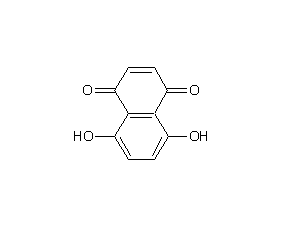
5,8-dihydroxy-1,4-naphthoquinone

5,8-dihydroxy-1,4-naphthoquinone structural formula

5,8-dihydroxy-1,4-naphthoquinone structural formula

structural formula

business number 0519
molecular formula c10h6o4
molecular weight 190.16
label

naxi,

1,4-dihydroxynaphthoquinone,

5,8-dihydroxy-1,4-naphthalenedione,

naphthazarin

numbering system

cas number:475-38-7

mdl number:mfcd00001685

einecs number:207-495-4

rtecs number:ql7970000

brn number:880561

pubchem number:24851613

physical property data

1. character:undetermined

2. density (g/ m3,25/4): undetermined

3. relative vapor density (g/cm3,air=1): undetermined

4. melting point (ºc):220-230

5. boiling point (ºc,normal pressure): undetermined

6. boiling point (ºc,5.2kpa): undetermined

7. refractive index : undetermined

8. flash point (ºc): undetermined

9. specific optical rotation (º): undetermined

10. autoignition point or ignition temperature (ºc): undetermined

11. vapor pressure (kpa,25ºc): undetermined

12. saturated vapor pressure (kpa,60ºc): undetermined

13. heat of combustion (kj/mol): undetermined

14. critical temperature (ºc): undetermined

15. critical pressure (kpa): undetermined

16. oil and water (octanol/water) logarithmic value of the partition coefficient: undetermined

17. explosion limit (%,v/v): undetermined

18. lower explosion limit (%,v/v): undetermined

19. solubility: undetermined

toxicological data

mutagenicity data: microbial organismstestsystemic mutation: bacteriasalmonella typhimurium:100ug/tablet

ecological data

this substance may be harmful to the environment, and special attention should be paid to water bodies.

molecular structure data

1 molar refractive index:46.66

2 molar volumem3/mol)119.4

3 isotonic specific volume (90.2k): 360.9

4 surface tensiondyne/cm)83.5

5 polarizability(10-24cm318.50

compute chemical data

1. reference value for hydrophobic parameter calculation (xlogp): 1.8

2. number of hydrogen bond donors: 2

3. number of hydrogen bond acceptors: 4

4. number of rotatable chemical bonds: 0

5. number of tautomers: 6

6. topological molecule polar surface area 74.6

7. number of heavy atoms: 14

8. surface charge: 0

9. complexity: 277

10. number of isotope atoms: 0

11. determine the number of atomic stereocenters: 0

12. uncertain number of atomic stereocenters: 0

13. determine the number of chemical bond stereocenters: 0

14. number of uncertain chemical bond stereocenters: 0

15. number of covalent bond units: 1

properties and stability

use and store according to specifications, will not decompose, and avoid contact with oxides

storage method

save in a sealed manner and place it in a ventilated and dry place to avoid contact with other oxides.

synthesis method

none

purpose

none

bdmaee:bis (2-dimethylaminoethyl) ether

cas no:3033-62-3

china supplier

for more information, please contact the following email:

email:sales@newtopchem.com

email:service@newtopchem.com

email:technical@newtopchem.com

BDMAEE Manufacture !