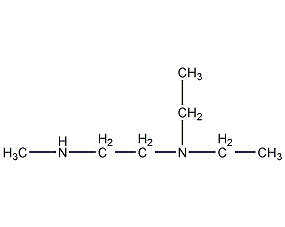
n,n-diethyl-n’-methylethylenediamine n,n-diethyl-n’-methylethylenediamine

N,N-diethyl-N'-methylethylenediamine structural formula

n,n-diethyl-n'-methylethylenediamine structural formula

structural formula

business number 02qn
molecular formula c7h18n2
molecular weight 130.23
label

[2-(diethylamino)ethyl]methylamine,

2-(diethylamino)-n-methylethylamine,

n,n-diethyl-n’-methylenediamine,

n,n-diethyl-n’-methylethylenediamine,

diethyl(2-methylaminoethyl)amine

numbering system

cas number:104-79-0

mdl number:mfcd00009053

einecs number:203-238-5

rtecs number:none

brn number:none

pubchem number:24858647

physical property data

1. properties: undetermined

2. density (g/ml, 20℃): 0.805

3. relative vapor density (g/ml, air=1) : undetermined

4. melting point (ºc): undetermined

5. boiling point (ºc, normal pressure): 157-160

6. boiling point ( ºc, kpa): not determined

7. refractive index: 1.4296

8. flash point (ºc): not determined

9. specific rotation ( º): not determined

10. autoignition point or ignition temperature (ºc): not determined

11. vapor pressure (mmhg, 20.2ºc): not determined

12. saturated vapor pressure (kpa, ºc): undetermined

13. heat of combustion (kj/mol): undetermined

14. critical temperature (ºc): undetermined

15. critical pressure (kpa): undetermined

16. log value of oil-water (octanol/water) partition coefficient: undetermined

17. explosion upper limit (%, v/v): undetermined

18. explosion lower limit (%, v/v): undetermined

19. solubility: undetermined

toxicological data

none

ecological data

none

molecular structure data

1. molar refractive index: 41.79

2. molar volume (cm3/mol): 160.1

3. isotonic specific volume (90.2k ): 364.2

4. surface tension (dyne/cm): 26.7

5. dielectric constant: 2.27

6. dipole moment (10-24cm3):

7. polarizability: 16.56

compute chemical data

1. reference value for hydrophobic parameter calculation (xlogp): 0.6

2. number of hydrogen bond donors: 1

3. number of hydrogen bond acceptors: 2

4. number of rotatable chemical bonds: 5

5. number of tautomers: none

6. topological molecule polar surface area 15.3

7. number of heavy atoms: 9

8. surface charge: 0

9. complexity: 50.9

10.the number of isotope atoms: 0

11. the number of determined atomic stereocenters: 0

12. the number of uncertain atomic stereocenters: 0

13. determined number of stereocenters of chemical bonds: 0

14. number of uncertain stereocenters of chemical bonds: 0

15. number of covalent bond units: 1

properties and stability

none

storage method

none

synthesis method

none

purpose

none

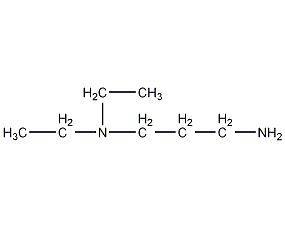
n,n-diethyl-1,3-propanediamine n,n-diethyl-1,3-propanediamine

n,n-diethyl-1,3-propanediamine structural formula

structural formula

business number 02qm
molecular formula c7h18n2
molecular weight 130.23
label

diethylaminopropylamine,

diethylaminopropane,

n,n-diethyl-1,3-diaminopropane,

3-diethylaminopropylamine,

diethylamino propylamine,

n,n-diethyl-1,3-diaminopropane,

3-diethylamino propylamine,

curing agent for epoxy resin,

nitrogen-containing compound solvents,

extracting agent

numbering system

cas number:104-78-9

mdl number:mfcd00008218

einecs number:203-236-4

rtecs number:tx7350000

brn number:741879

pubchem number:24894238

physical property data

1. properties: colorless liquid with fishy smell.

2. density (g/ml, 20℃): 0.82

3. relative vapor density (g/ml, air=1): 4.4

4. melting point (ºc): -60

5. boiling point (ºc, normal pressure): 164~168

6. freezing point (ºc): -100

7. refractive index (20ºc): 1.4416

8. flash point (ºc): 58

9. vapor pressure (mmhg, 70ºc): 19.5

10. solubility: miscible with water.

toxicological data

1. skin/eye irritation: start irritation test: rabbit skin contact, 100μg/24h

2. acute toxicity: rat oral ld50: 1410mg/kg; rabbit skin contact ld50: 750μl /kg

ecological data

this substance is harmful to the environment, and special attention should be paid to the pollution of water bodies.

molecular structure data

1. molar refractive index: 41.73

2. molar volume (cm3/mol): 155.0

3. isotonic specific volume (90.2k): 365.3

4. surface tension (dyne/cm): 30.8

5. dielectric constant: 2.27

6. dipole moment (10-24cm3):

7. polarizability: 16.54

compute chemical data

1. reference value for hydrophobic parameter calculation (xlogp): 0.4

2. number of hydrogen bond donors: 1

3. number of hydrogen bond acceptors: 2

4. number of rotatable chemical bonds: 5

5. number of tautomers: none

6. topological molecule polar surface area 29.3

7. number of heavy atoms: 9

8. surface charge: 0

9. complexity: 50.9

10. number of isotope atoms: 0

11. determine the number of atomic stereocenters: 0

12. uncertain number of atomic stereocenters: 0

13. determine the number of chemical bond stereocenters: 0

14. number of uncertain chemical bond stereocenters: 0

15. number of covalent bond units: 1

properties and stability

avoid contact with strong oxidants, acids, acid chlorides, acid anhydrides, and carbon dioxide. colorless viscous liquid. miscible with water and has an ammonia smell. it is flammable in case of open flame, high temperature and strong oxidant. highly toxic.

storage method

store in a cool, ventilated warehouse. keep away from fire and heat sources. protect from direct sunlight. keep container tightly sealed. they should be stored separately from oxidants, acids, acid chlorides, acid anhydrides and carbon dioxide, and avoid mixed storage. use explosion-proof lighting and ventilation facilities. it is prohibited to use mechanical equipment and tools that are prone to sparks. the storage area should be equipped with emergency release equipment and suitable containment materials.

synthesis method

it is obtained by the addition of acrylonitrile and diethylamine and then reduction. add diethylamine into the reaction kettle, cool to 0°c, start stirring and add acrylonitrile dropwise, and the temperature will gradually increase to 7°c automatically. after adding acrylonitrile, raise the temperature to 45°c, continue stirring the reaction for 2 hours, and leave it overnight. distill under reduced pressure to obtain diethylaminopropionitrile. add diethylaminopropionitrile, reaction medium methanolamine saturated solution and catalyst skeleton nickel into the autoclave, introduce hydrogen gas to carry out hydrogenation reduction reaction, and the reaction temperature rises to 100°c until the reaction system no longer absorbs hydrogen. then it is cooled and placed, and the catalyst is recovered by filtration. the filtrate is added to a distillation device to evaporate the methanol and then is fractionated to obtain the finished product.

purpose

since the molecule of this product contains two active hydrogens and a tertiary amine group that promotes the curing reaction of epoxy resin, it can be used as a curing agent for epoxy resin. this product cures slowly and has a long service life. it is suitable for small castings, laminates and adhesives. the dosage is 6 to 12 parts, and the curing conditions are 60℃/4h+120℃/1h. this product has low viscosity and is easy to use. products cured with this product have good electrical properties and low-temperature characteristics, with a heat distortion temperature of about 100°c. this product is also used as solvent, extraction agent and organic synthesis intermediate.

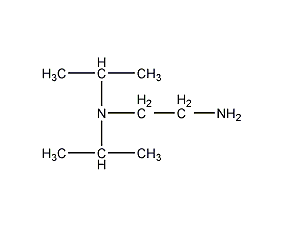
n,n-diisopropylethylenediamine n,n-diisopropylethylenediamine

N,N-diisopropylethylenediamine structural formula

n,n-diisopropylethylenediamine structural formula

structural formula

business number 03d8
molecular formula c8h20n2
molecular weight 144.26
label

n,n-diisopropylethylenediamine,

n,n-diisopropylethylenediamine,

n,n-diisopropylaminoethylamine,

1,2-bis-(isopropylamino)-ethane,

n,n-diisopropyl-ethylenediamin,

usafam-2,

n,n-diisoprylamino ethylamine,

n,n-diisopropylamino,

2-(diisopropylamino)ethylamine,

2-aminoethyldiisopropylamine,

n,n-diisopropylamino ethylamine,

aliphatic compounds

numbering system

cas number:121-05-1

mdl number:mfcd00015015

einecs number:204-447-4

rtecs number:kv4200000

brn number:1734800

pubchem number:24863945

physical property data

none

toxicological data

1. acute toxicity: mouse peritoneal cavity ld50: 200mg/kg

ecological data

none

molecular structure data

1. molar refractive index: 46.28

2. molar volume (cm3/mol): 172.2

3. isotonic specific volume (90.2k ): 399.9

4. surface tension (dyne/cm): 29.0

5. dielectric constant:

6. dipole moment (10-24cm3):

7. polarizability: 18.34

compute chemical data

1. reference value for hydrophobic parameter calculation (xlogp): 0.9

2. number of hydrogen bond donors: 1

3. number of hydrogen bond acceptors: 2

4. number of rotatable chemical bonds: 4

5. number of tautomers: none

6. topological molecule polar surface area 29.3

7. number of heavy atoms: 10

8. surface charge: 0

9. complexity: 71.3

10. number of isotope atoms: 0

11. determine the number of atomic stereocenters: 0

12. uncertain number of atomic stereocenters: 0

13. determine the number of chemical bond stereocenters: 0

14. number of uncertain chemical bond stereocenters: 0

15. number of covalent bond units: 1

properties and stability

1. basic properties

this product is a colorless liquid. boiling point 169-171℃.

storage method

none

synthesis method

none

purpose

none

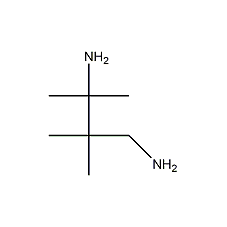
n,n,n’,n’-tetramethyl-1,3-propanediamine n,n,n’,n’-tetramethyl-1,3-propanediamine

N,N,N',N'-tetramethyl-1,3-propanediamine structural formula

n,n,n',n'-tetramethyl-1,3-propanediamine structural formula

structural formula

business number 032g
molecular formula c7h18n2
molecular weight 130.23
label

tetramethylpropylenediamine,

n,n,n’,n’-tetramethyl-1,3-diaminepropane,

tetramethyl-1,3-diaminopropane,

bis[(dimethylamino)methyl]methane,

1,3-bis(dimethylamino)propane,

linear compound

numbering system

cas number:110-95-2

mdl number:mfcd00008337

einecs number:203-818-8

rtecs number:tx8400000

brn number:none

pubchem number:24879082

physical property data

1. characteristics: colorless liquid.

2. density (g/ml,15): 0.779

3. relative vapor density (g/ml,air=1): undetermined

4. melting point (ºc): 95-98

5. boiling point (ºc,normal pressure): 145-146

6. boiling point (ºc,kpa): undetermined

7. refractive index: 1.4234

8. flashpoint (ºc): 32

9. specific optical rotation (º): undetermined

10. autoignition point or ignition temperature (ºc): undetermined

11. vapor pressure (mmhg,145ºc): 760

12. saturated vapor pressure (kpa, ºc): undetermined

13. heat of combustion (kj/mol): undetermined

14. critical temperature (ºc): undetermined

15. critical pressure (kpa): undetermined

16. oil and water (octanol/log value of the partition coefficient for water: undetermined

17. explosion limit (%,v/v): undetermined

ecological data

this substance is slightly harmful to water.

molecular structure data

5. molecular property data:

1. molar refractive index: 41.48

2. molar volume (m3/mol):151.5

3. isotonic specific volume (90.2k):358.9

4. surface tension (dyne/cm):31.4

5. polarizability10-24cm3):16.44

compute chemical data

1. reference value for hydrophobic parameter calculation (xlogp): 0.7

2. number of hydrogen bond donors: 0

3. number of hydrogen bond acceptors: 2

4. number of rotatable chemical bonds: 4

5. number of tautomers: none

6. topological molecule polar surface area 6.5

7. number of heavy atoms: 9

8. surface charge: 0

9. complexity: 51.9

10. number of isotope atoms: 0

11. determine the number of atomic stereocenters: 0

12. uncertain number of atomic stereocenters: 0

13. determine the number of chemical bond stereocenters: 0

14. number of uncertain chemical bond stereocenters: 0

15. number of covalent bond units: 1

properties and stability

does not decompose at room temperature and pressure. contact with oxidants and acids is prohibited.

storage method

stored in a cool, ventilated warehouse. keep away from fire and anti-static. they should be stored separately from oxidants and acids, and avoid mixed storage. equipped with the appropriate variety and quantity of fire equipment. suitable materials should be available in the storage area to contain spills.

synthesis method

none yet

purpose

none yet

w roman’; mso-bidi-font-family: arial”>(10-24cm3):16.44

compute chemical data

1. reference value for hydrophobic parameter calculation (xlogp): 0.7

2. number of hydrogen bond donors: 0

3. number of hydrogen bond acceptors: 2

4. number of rotatable chemical bonds: 4

5. number of tautomers: none

6. topological molecule polar surface area 6.5

7. number of heavy atoms: 9

8. surface charge: 0

9. complexity: 51.9

10. number of isotope atoms: 0

11. determine the number of atomic stereocenters: 0

12. uncertain number of atomic stereocenters: 0

13. determine the number of chemical bond stereocenters: 0

14. number of uncertain chemical bond stereocenters: 0

15. number of covalent bond units: 1

properties and stability

does not decompose at room temperature and pressure. contact with oxidants and acids is prohibited.

storage method

stored in a cool, ventilated warehouse. keep away from fire and anti-static. they should be stored separately from oxidants and acids, and avoid mixed storage. equipped with the appropriate variety and quantity of fire equipment. suitable materials should be available in the storage area to contain spills.

synthesis method

none yet

purpose

none yet

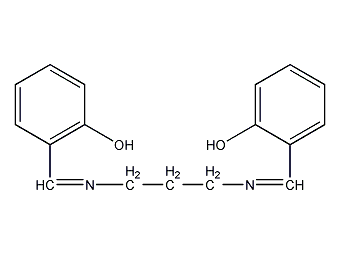
n,n’-disalicylidene-1,3-propanediamine n,n’-bis(salicylidene)-1,3-propanediamine

N,N'-disalicylicaldehyde-1,3-propanediamine structural formula

n,n'-disalicylicaldehyde-1,3-propanediamine structural formula

structural formula

business number 03cn
molecular formula c17h18n2o2
molecular weight 282.34
label

n,n’-salicylaldehyde propylenediamine,

n,n’-disalicylidene-1,3-diaminopropane,

n,n’-aqueous disalicylate-1,3-diaminopropane,

n,n’-disalicylicaldehyde-1,3-propanediamine,

1,3-bis(o-hydroxybenzylideneamino)propane,

2-((e)-[((e)-3-([(e)-(2-hydroxyphenyl)methylidene]amino)propyl)imino]methyl)phenol,

alpha,alpha’-(trimethylenedinitrilo)di-o-cresol,

disalicylicenepropanediamine,

disalicylidene-1,3-propanediamine,

disalicylidenepropa,

heterocyclic compounds

numbering system

cas number:120-70-7

mdl number:mfcd00002245

einecs number:204-418-6

rtecs number:none

brn number:2057483

pubchem number:24855082

physical property data

none yet

toxicological data

1, acute toxicity: rat oral ld50: 1g/kg

mouse oral ld50: 1070mg/kg

mouse peritoneal cavity ld50: 117mg/kg

mouse subcutaneously ld50: 225mg/kg

rabbit subcutaneous ld50: 790mg/kg

2, other multiple dose toxicity: livestock tdlo: 350mg/kg/4w-i

3, tumorigenic toxicity: mice subcutaneously tdlo: 1000mg/kg/25w-i

ecological data

none yet

molecular structure data

5. molecular property data:

1. molar refractive index: 83.60

2. molar volumem3/ mol253.2

3. isotonic ratio90.2k651.9

4. surface tension(dyne/cm)43.9

5. dielectric constant:

6. dipole moment10 -24cm3)

7. <span style="font -size: 9pt; font-family: 宋体; mso-ascii-font-family: arial; mso-han��area (tpsa):58.2

7. heavy atoms quantity: 21

8. surface charge :0

9. complexity :538

10. number of isotope atoms:0

11. determine the number of atomic stereocenters:0

12. uncertain number of atomic stereocenters:0

13. determine the number of stereocenters of chemical bonds:2

14. uncertain number of chemical bond stereocenters:0

15. number of covalent bond units: 1

properties and stability

none yet

storage method

none yet

synthesis method

none yet

purpose

none yet

0 level1 lfo1; tab-stops: list 18.0pt” align=left>13. determine the number of stereocenters of chemical bonds:2

14. uncertain number of chemical bond stereocenters:0

15. number of covalent bond units: 1

properties and stability

none yet

storage method

none yet

synthesis method

none yet

purpose

none yet

n,n’-dimethylethylenediamine n,n’-dimethylethylenediamine

N,N'-dimethylethylenediamine structural formula

n,n'-dimethylethylenediamine structural formula

structural formula

business number 031v
molecular formula c4h12n2
molecular weight 88.15
label

dimethyl vinyl diamine,

n,n’-dimethylvinyldiamine,

n,n’-dimethyl-1,2-ethanediamine,

1,2-bis(methylamino)ethane,

linear compound

numbering system

cas number:110-70-3

mdl number:mfcd00008290

einecs number:203-793-3

rtecs number:kv4250000

brn number:878142

pubchem number:24893484

physical property data

1. characteristics: colorless liquid , with an amine-like smell.

2. density (g/ml,25): 0.818

3. relative vapor density (g/ml,air=1): undetermined

4. melting point (ºc): undetermined

5. boiling point (ºc,normal pressure): 118-119

6. boiling point (ºc,kpa): undetermined

7. refractive index: undetermined

8. flashpoint (ºc): 28

9. specific optical rotation (º): undetermined

10. autoignition point or ignition temperature (ºc): undetermined

11. vapor pressure (mmhg,ºc): undetermined

12. saturated vapor pressure (kpa, ºc): undetermined

13. heat of combustion (kj/mol): undetermined

14. critical temperature (ºc): undetermined

15. critical pressure (kpa): undetermined

16. oil and water (octanol/log value of the partition coefficient for water: undetermined

17. explosion limit (%,v/v): undetermined

acute toxicity: mouse peritoneum ld5o: 200mg/kg

ecological data

none yet

molecular structure data

5. molecular property data:

1. molar refractive index: 27.77

2. molar volume (m3/mol):112.1

3. isotonic specific volume (90.2k):247.2

4. surface tension (dyne/cm):23.5

5. polarizability10-24cm3):11.00

compute chemical data

1. reference value for hydrophobic parameter calculation (xlogp): none

2. number of hydrogen bond donors: 2

3. number of hydrogen bond acceptors: 2

4. number of rotatable chemical bonds: 3

5. number of tautomers: none

6. topological molecule polar surface area 24.1

7. number of heavy atoms: 6

8. surface charge: 0

9. complexity: 17.5

10. number of isotope atoms: 0

11. determine the number of atomic stereocenters: 0

12. uncertain number of atomic stereocenters: 0

13. determine the number of chemical bond stereocenters: 0

14. number of uncertain chemical bond stereocenters: 0

15. number of covalent bond units: 1

properties and stability

none yet

storage method

none yet

synthesis method

none yet

purpose

none yet

/sup>):11.00

compute chemical data

1. reference value for hydrophobic parameter calculation (xlogp): none

2. number of hydrogen bond donors: 2

3. number of hydrogen bond acceptors: 2

4. number of rotatable chemical bonds: 3

5. number of tautomers: none

6. topological molecule polar surface area 24.1

7. number of heavy atoms: 6

8. surface charge: 0

9. complexity: 17.5

10. number of isotope atoms: 0

11. determine the number of atomic stereocenters: 0

12. uncertain number of atomic stereocenters: 0

13. determine the number of chemical bond stereocenters: 0

14. number of uncertain chemical bond stereocenters: 0

15. number of covalent bond units: 1

properties and stability

none yet

storage method

none yet

synthesis method

none yet

purpose

none yet

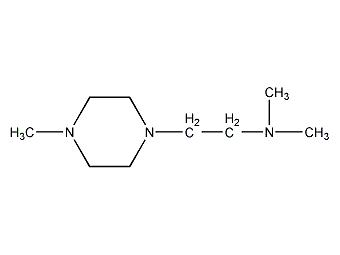
n,n,4-trimethylpiperazine-1-ethylamine 1-(2-dimethylaminoethyl)-4-methylpiperazine

N,N,4-trimethylpiperazine-1-ethylamine structural formula

n,n,4-trimethylpiperazine-1-ethylamine structural formula

structural formula

business number 02pt
molecular formula c9h21n3
molecular weight 171.28
label

n,n,4-trimethylpiperazine-1-ethylamine,

1-(2-dimethylaminoethyl)-4-methylpiperazine,

1-methyl-4-dimethylaminoethylpiperazine,

1-(2-dimethylaminoethyl)-4-methylpiperazine,

n,n-4-trimethyl-1-piperazine ethanamine,

1-(2-(dimethylamino)ethyl)-4-methyl-piperazin,

1-(2-(n,n-dimethylamino)ethyl)-4-methylpiperazine,

1-piperazineethanamine, n,n,4-trime

numbering system

cas number:104-19-8

mdl number:mfcd00059773

einecs number:203-183-7

rtecs number:tl6125000

brn number:none

pubchem id:none

physical property data

1. properties: undetermined

2. density (g/ml, 20℃): 0.89

3. relative vapor density (g/ml, air=1) : undetermined

4. melting point (ºc): undetermined

5. boiling point (ºc, normal pressure): undetermined

6. boiling point (ºc , 12mmhg): 96

7. refractive index: not determined

8. flash point (ºc): not determined

9. specific rotation (º ): undetermined

10. autoignition point or ignition temperature (ºc): undetermined

11. vapor pressure (mmhg, 20.2ºc): undetermined

12. saturated vapor pressure (kpa, ºc): undetermined

13. heat of combustion (kj/mol): undetermined

14. critical temperature (ºc): undetermined determined

15. critical pressure (kpa): undetermined

16. log value of oil-water (octanol/water) partition coefficient: undetermined

17 . explosion upper limit (%, v/v): undetermined

18. explosion lower limit (%, v/v): undetermined

19. solubility: undetermined

p>

toxicological data

1. skin/eye irritation: start irritation test: rabbit skin contact, 100μg/24h; standard dresser test: rabbit skin contact, 5mg/24hreaction severity, strong reaction; standard dresser test: rabbit eye contact, 750μg/ 24hreaction severity, strong reaction; 2. acute toxicity: rat oral ld50: 1420μl/kg;sp; rabbit skin contact ld50: 390μl/kg;

ecological data

none yet

molecular structure data

1. molar refractive index: 52.60

2. molar volume (cm3/mol): 186.4

3. isotonic specific volume (90.2k ): 439.8

4. surface tension (dyne/cm): 31.0

5. dielectric constant:

6. dipole moment (10-24cm3):

7. polarizability: 20.85

compute chemical data

1. reference value for hydrophobic parameter calculation (xlogp): 0.1

2. number of hydrogen bond donors: 0

3. number of hydrogen bond acceptors: 3

4. number of rotatable chemical bonds: 3

5. number of tautomers: none

6. topological molecule polar surface area 9.7

7. number of heavy atoms: 12

8. surface charge: 0

9. complexity: 117

10. number of isotope atoms: 0

11. determine the number of atomic stereocenters: 0

12. uncertain number of atomic stereocenters: 0

13. determine the number of chemical bond stereocenters: 0

14. number of uncertain chemical bond stereocenters: 0

15. number of covalent bond units: 1

properties and stability

none yet

storage method

none yet

synthesis method

none yet

purpose

none yet

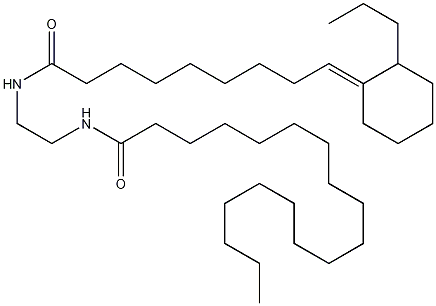
n,n’-ethylenebisoleamide n,n’-ethylenebisoleamide

N,N'-ethylene oleamide structural formula

n,n'-ethylene oleamide structural formula

structural formula

business number 030z
molecular formula c38h72n2o2
molecular weight 588.99
label

(z,z)-n,n’-1,2-ethylenediylidenebis-9-octadecenamide,

ethylene dioleamide,

ethylene bisoleamide,

dioleylethylenediamine,

ethylene bis i oleamide,

aliphatic compounds

numbering system

cas number:110-31-6

mdl number:none

einecs number:203-756-1

rtecs number:none

brn number:none

pubchem id:none

physical property data

1. character: undetermined

2. density (g/ml,25): undetermined

3. relative vapor density (g/ml,air=1): undetermined

4. melting point (ºc): 115-118

5. boiling point (ºc,normal pressure):undetermined span>

6. boiling point (ºc,kpa): undetermined

7. refractive index: undetermined

8. flashpoint (ºc): undetermined

9. specific optical rotation (º): undetermined

10. autoignition point or ignition temperature (ºc): undetermined

11. vapor pressure (mmhg,25ºc): undetermined

12. saturated vapor pressure (kpa, ºc): undetermined

13. heat of combustion (kj/mol): undetermined

14. critical temperature (ºc): undetermined

15. critical pressure (kpa): undetermined

16. oil and water (octanol/log value of the partition coefficient for water: undetermined

17. explosion limit (%,v/v): undetermined

5. interchange number of isomers: 3

6. topological molecules polar surface area (tpsa):58.2

7. heavy atoms quantity: 42

8. surface charge :0

9. complexity :575

10. number of isotope atoms:0

11. determine the number of atomic stereocenters:0

12. uncertain number of atomic stereocenters:0

13. determine the number of stereocenters of chemical bonds:0

14. uncertain number of chemical bond stereocenters:0

15. number of covalent bond units: 1

properties and stability

none yet

storage method

none yet

synthesis method

none yet

purpose

none yet

mso-fareast-font-family: arial”>11. determine the number of atomic stereocenters:0

12. uncertain number of atomic stereocenters:0

13. determine the number of stereocenters of chemical bonds:0

14. uncertain number of chemical bond stereocenters:0

15. number of covalent bond units: 1

properties and stability

none yet

storage method

none yet

synthesis method

none yet

purpose

none yet

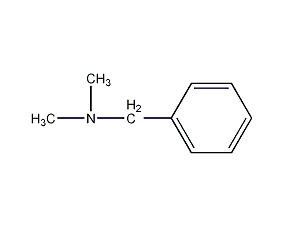
n,n-dimethylbenzylamine n,n-dimethylbenzylamine

n,n-dimethylbenzylamine structural formula

structural formula

business number 02pb
molecular formula c9h13n
molecular weight 135.21
label

n,n-dimethylbenzylamine,

benzyldimethylamine,

dimethylbenzylamine,

n,n-dimethylbenzylamine,

n-benzyldimethylamine,

benzyl dimethylamine,

n-benzyldimethylamine,

tertiary amine curing agent,

dehydrogenation catalyst,

acid neutralizer,

preservative

numbering system

cas number:103-83-3

mdl number:mfcd00008329

einecs number:203-149-1

rtecs number:dp4500000

brn number:1099620

pubchem number:24848115

physical property data

1. properties: colorless to light yellow liquid with ammonia smell.

2. density (g/ml, 27℃): 0.9000

3. relative vapor density (g/ml, air=1): undetermined

4. melting point (ºc): -75

5. boiling point (ºc, normal pressure): 183~184

6. boiling point (ºc, 2.4kpa): 65~68

7. refractive index: 1.501

8. flash point (ºc): 54

9. specific rotation (º): undetermined

10. autoignition point or ignition temperature (ºc): undetermined

11. vapor pressure (mmhg, ºc):

12. saturated vapor pressure (kpa, ºc): undetermined

13. heat of combustion (kj/mol): undetermined

14. critical temperature (ºc): undetermined

15. critical pressure (kpa): undetermined

16. log value of oil-water (octanol/water) partition coefficient: undetermined

17. explosion upper limit (%, v/v) : undetermined

18. lower explosion limit (%, v/v): undetermined

19. solubility: slightly soluble in cold water, soluble in hot water, miscible in alcohol, ether.

toxicological data

1. skin/eye irritation:

standard dresser test: rabbit skin contact, 500mg/4hreaction severity, strong reaction;

standard dresser test: rabbit eye contact, 5mgreaction severity, strong reaction;

2. acute toxicity: rat oral ld50: 265mg/kg;

rat inhalation lclo: 1200mg/m3/2h;

mice inhaled lclo: 1200mg/m3/2h;

        rabbit skin contact ld50: 1660mg/kg;

3. other multiple dose toxicity: rat inhalation tclo: 30mg/m3/4h/26w-i;

4. rabbit the lowest lethal dose is ld 250mg/kg. it has a weak excitatory effect on sympathetic nerves, but cannot inhibit tuberculosis bacteria. it is highly irritating and corrosive to skin and mucous membranes, and is also highly sensitizing.

ecological data

this substance may be harmful to the environment and it is recommended not to let it enter the environment.

molecular structure data

1. molar refractive index: 44.15

2. molar volume (cm3/mol): 146.0

3. isotonic specific volume (90.2k): 349.3

4. surface tension (dyne/cm): 32.7

5. dielectric constant:

6. dipole moment (10-24 cm3):

7. polarizability: 17.50

compute chemical data

1. reference value for hydrophobic parameter calculation (xlogp): none

2. number of hydrogen bond donors: 0

3. number of hydrogen bond acceptors: 1

4. number of rotatable chemical bonds: 2

5. number of tautomers: none

6. topological molecule polar surface area 3.2

7. number of heavy atoms: 10

8. surface charge: 0

9. complexity: 82.7

10. number of isotope atoms: 0

11. determine the number of atomic stereocenters: 0

12. uncertain number of atomic stereocenters: 0

13. determine the number of chemical bond stereocenters: 0

14. number of uncertain chemical bond stereocenters: 0

15. number of covalent bond units: 1

properties and stability

avoid contact with strong oxidants, acids, acid chlorides, and carbon dioxide.

exposure to air absorbs carbon dioxide and turns it into carbonates. flammable and toxic. it is recommended that operators wear self-priming filter dust masks, safety glasses, anti-toxic substance penetration overalls, and rubber gloves.

storage method

store in a cool, ventilated warehouse. keep away from fire and heat sources. protect from direct sunlight. keep container tightly sealed. they should be stored separately from oxidants, acids, acid chlorides, carbon dioxide, and food chemicals, and avoid mixed storage. use explosion-proof lighting and ventilation facilities. it is prohibited to use mechanical equipment and tools that are prone to sparks. the storage area should be equipped with emergency release equipment and suitable containment materials.

synthesis method

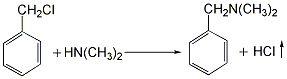
(1) obtained from the reaction of benzyl and dimethylamine. first add dimethylamine to the reaction pot, add benzyl chloride with stirring, and control the temperature below 25°c. after the dropwise addition is completed, stir the reaction at room temperature for 1 hour, then slowly increase the temperature to 55-60°c and continue the reaction for 6 hours. then add liquid caustic soda and let it stand for layering. take the oil layer, wash it with hot water, distill it under reduced pressure, and collect the 67-72°c (1.87kpa) fraction to obtain benzyldimethylamine. raw material consumption: dimethylamine 2666kg/t; benzyl chloride 860kg/t. (2) put 100kg of dimethylamine into the reaction kettle, slowly add 115kg of benzyl chloride dropwise under stirring and water bath cooling conditions, remove the cooling water after the dropwise addition, react at room temperature for 2 hours, and then heat to 50-60°c with steam. reaction 5h. after the reaction, drain the water in the kettle, wash it twice with hot water, stop stirring after washing, cool it with circulating water, and drain the water after 40 hours. collect the material phase to obtain the crude product. distill the crude product under reduced pressure and collect the fractions with a gas phase temperature of 70-72°c at 1.6kpa to obtain chemically pure n,n-dimethylbenzylamine.

purpose

this product is a commonly used tertiary amine curing agent for epoxy resin. the dosage is 6g/100g of resin, the service life is 4h, and the curing condition is 80℃ for 1h.
this product is also an organic synthesis intermediate and is used for the synthesis of quaternary ammonium salts and the drug chlormethionine, etc. it is also used as dehydrogenation catalyst, acid neutralizer, preservative and accelerator for electron microscope section embedding. used as a curing agent for epoxy resin, the reference dosage is 10 to 15 parts by mass, and the curing condition is 80°c/1h. it is an important organic synthesis intermediate, such as the synthesis of quaternary ammonium salts. it is also used as a dehydrogenation catalyst, preservative, acid neutralizer, accelerator for electron microscope section embedding, etc.

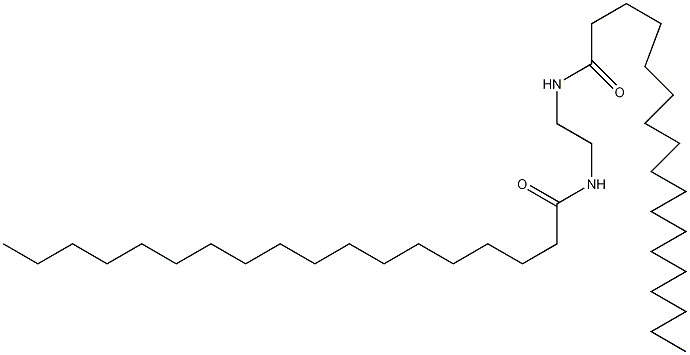
n,n’-ethylenebisoctadecanamide n,n’-ethylenebisoctadecanamide

n,n'-ethylene bisstearamide structural formula

structural formula

business number 030y
molecular formula c38h76n2o2
molecular weight 593.04
label

1,2-ethylenebisstearamide,

ethylene bis stearamide,

distearylethylenediamine,

1,2-ethylidene double stearamide,

n, n’-ethylene bistearic amide,

n,n’-ethylenebisstearamide,

lubricants,

release agent

numbering system

cas number:110-30-5

mdl number:mfcd00059224

einecs number:203-755-6

rtecs number:none

brn number:none

pubchem number:24867205

physical property data

1. properties: white to light yellow powder or granular matter.

2. density (g/ml, 25℃): 0.98

3. relative vapor density (g/ml, air=1): undetermined

4. melting point (ºc): 142~144

5. boiling point (ºc, normal pressure): undetermined

6. boiling point (ºc, kpa): undetermined

p>

7. refractive index: undetermined

8. flash point (ºc): 285

9. specific rotation (º): undetermined

10. autoignition point or ignition temperature (ºc): undetermined

11. vapor pressure (mmhg, 25ºc): undetermined

12. saturated vapor pressure (kpa , ºc): undetermined

13. heat of combustion (kj/mol): undetermined

14. critical temperature (ºc): undetermined

15 . critical pressure (kpa): undetermined

16. log value of oil-water (octanol/water) distribution coefficient: undetermined

17. explosion upper limit (%, v/v ): undetermined

18. lower explosion limit (%, v/v): undetermined

19. solubility: insoluble in water, ethanol, benzene, carbon tetrachloride, solvents such as glycerol are soluble in mixed xylenes, terpenes, butanol, methyl cellosolve and other high boiling point solvents and hot chlorinated hydrocarbons and aromatic hydrocarbon solvents at temperatures above the melting point. separate precipitates or colloids.

toxicological data

none yet

ecological data

molecular structure data

1. molar refractive index: 185.34

2. molar volume (cm3/mol): 667.6

3. isotonic specific volume (90.2k ): 1610.0

4. surface tension (dyne/cm): 33.8

5. polarizability (10-24cm3): 73.47

compute chemical data

1. reference value for hydrophobic parameter calculation (xlogp): 15.7

2. number of hydrogen bond donors: 2

3. number of hydrogen bond acceptors: 2

4. number of rotatable chemical bonds: 35

5. number of tautomers: 3

6. topological molecule polar surface area 58.2

7. number of heavy atoms: 42

8. surface charge: 0

9. complexity: 503

10. number of isotope atoms: 0

11. determine the number of atomic stereocenters: 0

12. uncertain number of atomic stereocenters: 0

13. determine the number of chemical bond stereocenters: 0

14. number of uncertain chemical bond stereocenters: 0

15. number of covalent bond units: 1

properties and stability

stable to acids, alkalis and media.

storage method

paper bag packaging. store in a cool, dry place. this product is toxic, so precautions should be taken when handling it.

synthesis method

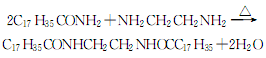
1. obtained from the reaction of stearic acid and ethylenediamine.

2. dissolve 1 mol of stearin the acid is put into the reaction kettle and heated to melt. continue to raise the temperature while stirring, and start adding ethylenediamine when the temperature reaches about 140°c. the amount added is equivalent to 1.5 times the mass fraction of stearic acid. the generated by-product water and low boiling point substances are separated through the water separator, and the reaction temperature is maintained at 140-160°c. when the separated water no longer contains ethylenediamine, the reaction is terminated, and the material is discharged while it is hot. after molding, it is cooled and packaged. .

3. add the measured ethylenediamine and antioxidant into the ethylenediamine metering tank, and then put a certain amount of stearic acid into the reaction kettle. replace the air in the reaction kettle with n2 three times, then add ethylenediamine, and heat the oil bath in the jacket of the reaction kettle. when the stearic acid is completely melted, start stirring and continue to heat up under the protection of nitrogen flow. control the heating rate. when the temperature reaches 120°c, react at a constant temperature for 2 hours. then add the catalyst to continue heating and control the heating rate. when the temperature reaches 180°c, keep the temperature constant for 3 hours. ~4h. determine the acid value of the product. if the acid value does not reach <10 mgkoh/g, add a catalyst and raise the temperature to 200°c until the acid value is qualified. then it is cooled to 160°c, quickly discharged, formed into flakes, and then crushed into products. the synthesis reaction formula is as follows:

the process control parameters are: the molar ratio of stearic acid to ethylenediamine is 1.7:1; composite antioxidant a+b is used, and the added amount is stearic acid input 0.03% of the amount; and protected by n2, kept at 120°c for 2 hours, then heated to 180°c at a rate of 1°c per minute, and kept at 180°c for condensation for 4 hours. the acid value of the product is ≤5mgkoh/g, the whiteness value is <5, and the melting point is 140~145℃.

purpose

1. this product is used as a lubricant for plastics, has good internal and external lubrication, and can be used as a release agent. mainly used in polyvinyl chloride, polyethylene, polypropylene, polystyrene, abs, phenolic, and amino resins. the dosage is 0.2 to 2 parts per 100 parts of resin.

2. adding this product to adhesives and waxes has the effect of preventing caking and good demoulding properties.

3. adding this product to paint and rubber can improve the surface gloss of baking paint and rubber products.

4. natural adhesives such as starch can be modified. mainly used as lubricant or release agent for polyvinyl chloride, polyethylene, polypropylene, polystyrene, abs, phenolic and amino resin, with good internal and external lubrication. the dosage is 0.2 to 2 parts per 100 parts of resin.

5. it has excellent lubrication performance, strong calcium salt resistance, and good drag reduction effect. it can be used for drilling in saturated salt water to reduce power consumption.

bdmaee:bis (2-dimethylaminoethyl) ether

cas no:3033-62-3

china supplier

for more information, please contact the following email:

email:sales@newtopchem.com

email:service@newtopchem.com

email:technical@newtopchem.com

BDMAEE Manufacture !