tetraethylammonium bromide tetraethylammonium bromide
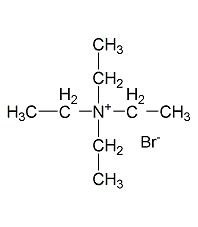
structural formula
| business number | 01gt |
|---|---|
| molecular formula | c8h20brn |
| molecular weight | 210.16 |
| label |
tea bromide, n,n,n-triethylacetolammonium bromide, tetraethylammonium bromide, tetraethylamine bromide, ethyl bromide, brothyl ammonium, bromuredetetraethylammoniummuredetetraethylammonium, etambro, (c2h5)4n(br), catalyst |
numbering system
cas number:71-91-0
mdl number:mfcd00011825
einecs number:200-769-4
rtecs number:bs5950000
brn number:3563430
pubchem id:none
physical property data
1. properties: white crystal, easy to absorb moisture. 2. density (g/ml, 25/4℃): 1.397
3. relative vapor density (g/ml, air=1): uncertain
4. melting point (ºc): 285 (dec.)(lit.)
5. boiling point (ºc, normal pressure): uncertain
6. boiling point (ºc, 5.2 kpa): uncertain
7. refractive index: 1.442-1.444
8. flash point (ºc): uncertain
9. specific rotation (º): uncertain
10. autoignition point or ignition temperature (ºc): uncertain
11. vapor pressure (kpa, 25 ºc): uncertain
12. saturated vapor pressure ( kpa, 60 ºc): uncertain
13. heat of combustion (kj/mol): uncertain
14. critical temperature (ºc): uncertain
15. critical pressure (kpa): uncertain
16. log value of oil-water (octanol/water) partition coefficient: uncertain
17. explosion upper limit (%, v /v): uncertain
18. lower explosion limit (%, v/v): uncertain
19. solubility: easily soluble in water, ethanol, chloroform and acetone, slightly soluble in benzene.
toxicological data
acute toxicity: rat intraperitoneal ld50: 108 mg/kg; rat subcutaneous injection ld50: 200 mg/kg; rat intravenous ld50: 63 mg/kg; mouse oral ld50: >2 mg/kg;
mouse abdominal ld50: 50 mg/kg; mouse intravenous ld50: 14200 ug/kg; dog intravenous ld50: 55 mg/kg; rabbit intravenous ld50: 72 mg/kg;
ecological data
none
molecular structure data
none
compute chemical data
1. reference value for hydrophobic parameter calculation (xlogp): none
2. number of hydrogen bond donors: 0
3. number of hydrogen bond acceptors: 1
4. number of rotatable chemical bonds: 4
5. number of tautomers: none
6. topological molecule polar surface area 0
7. number of heavy atoms: 10
8. surface charge: 0
9. complexity: 47.5
10. number of isotope atoms: 0
11. determine the number of atomic stereocenters: 0
12. uncertain number of atomic stereocenters: 0
13. determine the number of chemical bond stereocenters: 0
14. number of uncertain chemical bond stereocenters: 0
15. number of covalent bond units: 2
properties and stability
easily soluble in water and ethanol.
storage method
this product should be stored in a sealed, cool, dry and dark place.
synthesis method
in a 250ml three-necked flask equipped with a reflux condenser and a stirrer, add 7ml (5g, 0.05mol) triethylamine, 4ml (5.5g, 0.05mol) bromoethane and 20ml, 1,2-dichloroethane. or benzene. reflux and heat for 1.5 to 2 hours. after cooling the reaction solution, crystals are precipitated, filtered, washed twice with a small amount of 1,2-dichloroethane or benzene, dried and stored in a desiccator. yield 8~10g.
purpose
for ion pair chromatography. tests gold, iridium, osmium, palladium, rhodium and ruthenium. polarographic analysis. used as a phase transfer catalyst in organic synthesis.
