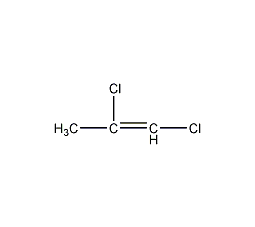
1,1-dichloropropene

1,1-dichloropropene structural formula

1,1-dichloropropene structural formula

structural formula

business number 05su
molecular formula c3h4cl2
molecular weight 110.97
label

1,1-dichloro-1-propene,

standards for analysis and testing

numbering system

cas number:563-58-6

mdl number:mfcd00000839

einecs number:none

rtecs number:none

brn number:1734809

pubchem id:none

physical property data

1. physical property data

5. flashpoint 11°f

toxicological data

none yet

ecological data

none yet

molecular structure data

5. molecular property data:

1. molar refractive index:25.54

2. molar volume (m3/mol): 94.2

3. isotonic specific volume (90.2k): 211.7

4. surface tension (dyne/cm): 25.5

5. polarizability10 -24cm3):10.12

compute chemical data

1. reference value for hydrophobic parameter calculation (xlogp): 2.6

2. number of hydrogen bond donors: 0

3. number of hydrogen bond acceptors: 0

4. number of rotatable chemical bonds: 0

5. number of tautomers: none

6. topological molecule polar surface area 0

7. number of heavy atoms: 5

8. surface charge: 0

9. complexity: 42.9

10. number of isotope atoms: 0

11. determine the number of atomic stereocenters: 0

12. uncertain number of atomic stereocenters: 0

13. determine the number of chemical bond stereocenters: 0

14. number of uncertain chemical bond stereocenters: 0

15. number of covalent bond units: 1

properties and stability

none yet

storage method

1. storage

should4save.

synthesis method

none yet

purpose

2. purpose

 standards for analysis and testing.

-pagination: wi-orphan” align=left>1. storage

should4save.

synthesis method

none yet

purpose

2. purpose

 standards for analysis and testing.

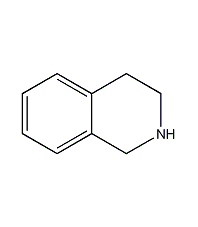
1,2,3,4-tetrahydroisoquinoline

1,2,3,4-tetrahydroisoquinoline structural formula

1,2,3,4-tetrahydroisoquinoline structural formula

structural formula

business number 023b
molecular formula c9h11n
molecular weight 133.19
label

tetrahydroisoquinoline,

tetrahydroisoquinoline

numbering system

cas number:91-21-4

mdl number:mfcd00006896

einecs number:202-050-0

rtecs number:nx4900000

brn number:116156

pubchem number:24899955

physical property data

1. characteristics: undetermined

2. density (g/ml, 25/4℃): undetermined

3. relative vapor density (g/ml, air =1): undetermined

4. melting point (ºc): -30-233

5. boiling point (ºc, normal pressure): 232-233

6. boiling point (ºc, 5.2kpa): not determined

7. refractive index: undetermined

8. flash point (ºc): not determined

9. specific rotation (º): undetermined

10. autoignition point or ignition temperature (ºc): undetermined

11. vapor pressure (kpa, 25ºc): undetermined

12. saturated vapor pressure (kpa, 60ºc): undetermined

13. heat of combustion (kj/mol): undetermined

14. critical temperature (ºc): undetermined

15. critical pressure (kpa): undetermined

16. log value of oil-water (octanol/water) partition coefficient: undetermined

17. explosion upper limit (%, v/v): undetermined

18. explosion lower limit (%, v/v): undetermined

19. solubility: not determined

toxicological data

none

ecological data

none

molecular structure data

1. molar refractive index: 41.77

2. molar volume (cm3/mol): 132.2

3. isotonic specific volume (90.2k ): 326.3

4. surface tension (dyne/cm): 37.0

5. polarizability (10-24cm3): 16.56

compute chemical data

1. reference value for hydrophobic parameter calculation (xlogp): none

2. number of hydrogen bond donors: 1

3. number of hydrogen bond acceptors: 1

4. number of rotatable chemical bonds: 0

5. number of tautomers: none

6. topological molecule polar surface area 12

7. number of heavy atoms: 10

8. surface charge: 0

9. complexity: 111

10. number of isotope atoms: 0

11. determine the number of atomic stereocenters: 0

12. uncertain number of atomic stereocenters: 0

13. determine the number of chemical bond stereocenters: 0

14. number of uncertain chemical bond stereocenters: 0

15. number of covalent bond units: 1

properties and stability

none yet

storage method

should be sealed and stored in a cool place.

synthesis method

reduction of isoquinoline with tin and hydrochloric acid or sodium and ethanol gives 1,2,3,4-tetrahydroisoquinoline.

purpose

used as a reagent for organic synthesis.

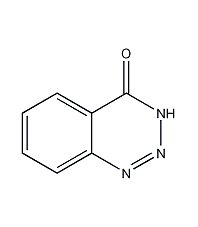
1,2,3-benzotriazin-4(3h)-one

1,2,3-benzotriazine-4(3H)-one structural formula

1,2,3-benzotriazine-4(3h)-one structural formula

structural formula

business number 0221
molecular formula c7h5n3o
molecular weight 147.13
label

1,2,3-benzotriazin-4-one,

1,2,3-benzotriazin-4-one

numbering system

cas number:90-16-4

mdl number:mfcd00052387

einecs number:201-971-5

rtecs number:dm0800000

brn number:124996

pubchem number:24860827

physical property data

none

toxicological data

none

ecological data

none

molecular structure data

1. molar refractive index 39.71

2. molar volume (cm3/mol): 99.5

3. isotonic specific volume (90.2k) :279.9

4. surface tension (dyne/cm): 62.6

5. polarizability (10-24cm3): 15.74

compute chemical data

1. reference value for hydrophobic parameter calculation (xlogp): none

2. number of hydrogen bond donors: 1

3. number of hydrogen bond acceptors: 3

4. number of rotatable chemical bonds: 0

5. number of tautomers: 3

6. topological molecule polar surface area 53.8

7. number of heavy atoms: 11

8. surface charge: 0

9. complexity: 202

10. number of isotope atoms: 0

11. determine the number of atomic stereocenters: 0

12. uncertain number of atomic stereocenters: 0

13. determine the number of chemical bond stereocenters: 0

14. number of uncertain chemical bond stereocenters: 0

15. number of covalent bond units: 1

properties and stability

none

storage method

none

synthesis method

none

purpose

none

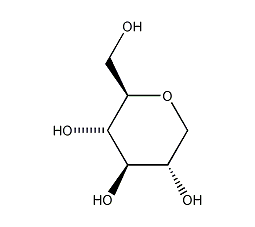
1,5-anhydroglucitol

1,5-Anhydroglucitol structural formula

1,5-anhydroglucitol structural formula

structural formula

business number 03z8
molecular formula c6h12o5
molecular weight 164.15
label

1,5-anhydro-d-sorbitol,

1,5-anhydroglucitol,

d-glucitol, 1,5-anhydro-,

(2r,3r,4r,5s)-2-(hydroxymethyl)oxane-3,4,5-triol,

1,5-anhydrosorbitol,

1-deoxy-d-glucopyranose

numbering system

cas number:154-58-5

mdl number:mfcd00067386

einecs number:205-829-3

rtecs number:none

brn number:none

pubchem number:24891181

physical property data

none

toxicological data

none

ecological data

none

molecular structure data

1. molar refractive index:35.66

2. molar volumecm3/mol107.0

3. isotonic specific volume90.2k306.0

4. surface tensiondyne/cm) : 66.8

5. dielectric constant: none

6. dipole moment10-24cm3:none available

7. polarizability:14.13

compute chemical data

none

properties and stability

none

storage method

none

synthesis method

none

purpose

none

t: ignore”>7. polarizability:14.13

compute chemical data

none

properties and stability

none

storage method

none

synthesis method

none

purpose

none

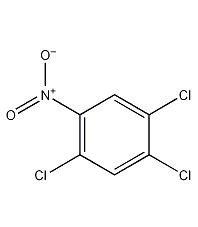
1,2,4-trichloro-5-nitrobenzene

1,2,4-Trichloro-5-nitrobenzene structural formula

1,2,4-trichloro-5-nitrobenzene structural formula

structural formula

business number 0215
molecular formula c6h2cl3no2
molecular weight 226
label

2,4,5-trichloronitrobenzene,

2,4,5-trichloronitrobenzene,

2,4,5-trichloro-1-nitrobenzene

numbering system

cas number:89-69-0

mdl number:mfcd00007072

einecs number:201-931-7

rtecs number:dc2275000

brn number:none

pubchem id:none

physical property data

1. properties: low melting point crystal

2. density (g/ml, 25/4℃): 1.79

3. relative vapor density (g/ml, air =1): undetermined

4. melting point (ºc): 49-57

5. boiling point (ºc, normal pressure): 288

6. boiling point (ºc, 5.2kpa): not determined

7. refractive index: not determined

8. flash point (ºc): 170

9. ratio optical rotation (º): not determined

10. autoignition point or ignition temperature (ºc): not determined

11. vapor pressure (kpa, 25ºc): not determined

p>

12. saturated vapor pressure (kpa, 60ºc): undetermined

13. heat of combustion (kj/mol): undetermined

14. critical temperature (ºc ): undetermined

15. critical pressure (kpa): undetermined

16. log value of oil-water (octanol/water) partition coefficient: undetermined

17. explosion upper limit (%, v/v): undetermined

18. explosion lower limit (%, v/v): undetermined

19. solubility: soluble in water.

toxicological data

none

ecological data

none

molecular structure data

1. molar refractive index: 47.48

2. molar volume (cm3/mol): 137.1

3. isotonic specific volume (90.2k ): 370.3

4. surface tension (dyne/cm): 53.2

5. polarizability (10-24cm3): 18.82

compute chemical data

1. reference value for hydrophobic parameter calculation (xlogp): none

2. number of hydrogen bond donors: 0

3. number of hydrogen bond acceptors: 2

4. number of rotatable chemical bonds: 0

5. number of tautomers: none

6. topological molecule polar surface area 45.8

7. number of heavy atoms: 12

8. surface charge: 0

9. complexity: 184

10. number of isotope atoms: 0

11. number of determined atomic stereocenters: 0

12. uncertain number of atomic stereocenters: 0

13. determine the number of stereocenters of chemical bonds: 0

14. uncertain number of stereocenters of chemical bonds: 0

15. number of covalent bond units: 1

properties and stability

none

storage method

stored sealed and protected from light.

synthesis method

prepared by nitration of 1,2,4-trichlorobenzene with mixed acid.

purpose

intermediate of fluobenzene salicylic acid.

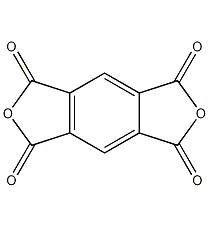
1,2,4,5-pyromellitic anhydride

1,2,4,5-pyromellitic anhydride structural formula

structural formula

business number 020m
molecular formula c10h2o6
molecular weight 218.12
label

1,2,4,5-benzenetetracarboxylic dianhydride,

pyromellitic anhydride,

1,2,4,5-pyromellitic dianhydride,

pyromellitic dianhydride,

pyromellitic anhydride,

1,2,4,5-benzene tetracarboxylic acid dianhydride,

1,2,4,5-pyromellitic dianhydride,

pyromellitic dianhydride,

hardener,

solid lubricants,

plasticizer,

cross-linking agent for polyester resin

numbering system

cas number:89-32-7

mdl number:mfcd00005005

einecs number:201-898-9

rtecs number:db9300000

brn number:213583

pubchem number:24865800

physical property data

1. properties: white needle-like crystals or powder. can sublime

2. density (g/ml, 20℃): 1.680

3. relative density (20℃, 4℃): 1.69

4 . melting point (ºc): 289

5. boiling point (ºc, normal pressure): 380400

6. boiling point (ºc, 3.9997kpa): 305~310

7. crystal phase standard combustion heat (enthalpy) (kj·mol-1): -3295.8

8. crystal phase standard claims heat (enthalpy) (kj·mol-1): -925.1

9. specific rotation (º): not available determined

10. autoignition point or ignition temperature (ºc): not determined

11. vapor pressure (kpa, 25ºc): not determined

12. saturated vapor pressure (kpa, 60ºc): undetermined

13. heat of combustion (kj/mol): undetermined

14. critical temperature (ºc): undetermined

15. critical pressure (kpa): undetermined

16. log value of oil-water (octanol/water) partition coefficient: undetermined

17. explosion upper limit ( %, v/v): undetermined

18. lower explosion limit (%, v/v): undetermined

19. solubility: soluble in dimethyl at room temperature formamide (dmf), dimethyl sulfoxide,γ-butyrolactone, n-methylpyrrolidone, acetone, methyl ethyl ketone, methyl isobutyl ketone, ethyl acetate, insoluble in chloroform, ether, n-hexane, and benzene. it hydrolyzes into pyromellitic acid when exposed to moist air.

toxicological data

toxicity classification poisoning.

acute toxicity oral – rat ld50: 2250 mg/kg; oral – mouse ld50: 2400 mg/kg.

irritates the skin and mucous membranes and can cause allergies, allergic reactions and other disorders.

ecological data

none

molecular structure data

1. molar refractive index: 45.11

2. molar volume (cm3/mol): 115.6

3. isotonic specific volume (90.2k): 360.8

4. surface tension (dyne/cm): 94.6

5. polarizability (10-24cm3): 17.88

compute chemical data

1. reference value for hydrophobic parameter calculation (xlogp): 0.7

2. number of hydrogen bond donors: 0

3. number of hydrogen bond acceptors: 6

4. number of rotatable chemical bonds: 0

5. number of tautomers: none

6. topological molecule polar surface area 86.7

7. number of heavy atoms: 16

8. surface charge: 0

9. complexity: 349

10. number of isotope atoms: 0

11. determine the number of atomic stereocenters: 0

12. uncertain number of atomic stereocenters: 0

13. determine the number of chemical bond stereocenters: 0

14. number of uncertain chemical bond stereocenters: 0

15. number of covalent bond units: 1

properties and stability

hydrolyzes to pyromellitic acid when exposed to moist air. poisonous! operators should wear work clothes, protective glasses and gloves.

storage method

this product should be sealed and stored in a cool, dry place away from light. keep away from fire, heat sources, sun protection and moisture-proof. double-layer packaging, with plastic film as the inner layer and cardboard barrels as the outer layer.

synthesis method

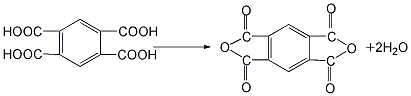
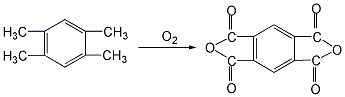
there are many ways to prepare it. the raw materials used can be xylene, trimethylbenzene, tetramethylbenzene or anthracene. oxidation methods include liquid phase method and gas phase method. 1. vapor-phase oxidation of tetramethylbenzene is characterized by its simple process, which can eliminate the dehydration to anhydride process. it does not require other oxidants (such as nitric acid, permanganic acid, chromic acid, etc.) except air, and does not require the catalyst required for the liquid phase. separation process, continuous production, easy to realize automated operation, is the main method of foreign development.

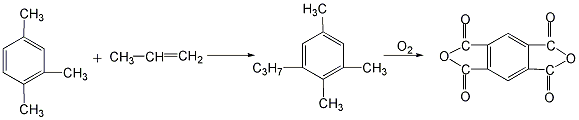
the raw materials used can also be from 1,2 starting from 4-trimethylbenzene, it is alkylated with propylene in the presence of a catalyst to generate 1,2,4-trimethyl-5-propylbenzene, and then catalytically oxidized with gas phase air to obtain pyromellitic dianhydride.

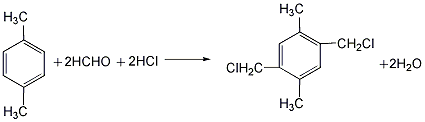
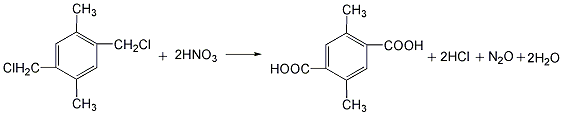
2. by xylene (p- xylene or m-xylene) is obtained by chloromethylation, oxidation and cyclization. the industrial product pyromellitic dianhydride is white to light yellow-green crystal. the melting point of the first-grade product is 284-287°c, and the melting point of the second-grade product is 283.5-287°c. when produced from 1,2,4-trimethylbenzene by the oxidation method, each ton of product consumes 3000kg of 1,2,4-trimethylbenzene and 1200kg of propylene.

3. carbon monoxide method: high purity is obtained by reacting trimethylene and carbon monoxide the intermediate aromatic aldehyde 2,4,5-trimethylbenzaldehyde is then oxidized to obtain pyromellitic acid, and finally dehydrated to generate pm-da. this method adopts a new carbonylation process with few side reactions, high product purity, high yield, strong selectivity, low corrosion to equipment, and meets environmental protection requirements. it also uses a set of equipment to switch between the production of trimellitic anhydride and pmda. , lower production costs.

purpose

1. this product is used as a curing agent for epoxy resin. it has excellent anti-leakage properties for epoxy resin used as casting and laminated motor materials. this product is also used as matting curing agent in the production of powder coatings, polyimide resin and film, high temperature resistant electrical insulating paint, solid lubricant, plasticizer and cross-linking agent of polyester resin, etc. 2.used as a curing agent for epoxy resin, the reference dosage is 56 parts by mass, and the curing condition is 180℃/15min. due to its high melting point, it is difficult to mix with epoxy resin. it can be dissolved in phthalic anhydride or maleic anhydride, and is often used as a curing agent when mixed with these anhydrides. the cured product has excellent heat resistance and physical and mechanical properties, and the deformation temperature can reach 200~250℃. it is also used in the manufacture of polyimide, polyimide, polyester resin, plasticizers, surfactants, water-soluble alkyd resins, phthalocyanine blue dyes and fungicides, etc. it is also used as solid lubricant, urea-formaldehyde resin stabilizer, corrosion inhibitor, radiation protection agent and electronic photography toner.

phthalic anhydride or maleic anhydride is often mixed with these acid anhydrides and used as a curing agent. the cured product has excellent heat resistance and physical and mechanical properties, and the deformation temperature can reach 200~250℃. it is also used in the manufacture of polyimide, polyimide, polyester resin, plasticizers, surfactants, water-soluble alkyd resins, phthalocyanine blue dyes and fungicides, etc. it is also used as solid lubricant, urea-formaldehyde resin stabilizer, corrosion inhibitor, radiation protection agent and electronic photography toner.

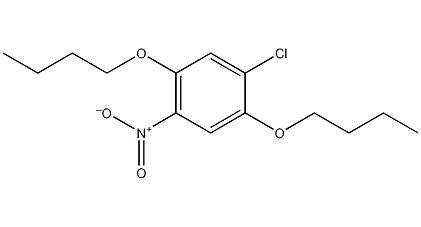
1,4-dibutoxy-2-chloro-5-nitrobenzene

1,4-dibutoxy-2-chloro-5-nitrobenzene structural formula

1,4-dibutoxy-2-chloro-5-nitrobenzene structural formula

structural formula

business number 020l
molecular formula c14h20clno4
molecular weight 301.77
label

1-chloro-2,5-dibutoxy-4-nitrobenzene,

1-chloro-2,5-dibutoxy-4-nitrobenzene

numbering system

cas number:89-30-5

mdl number:none

einecs number:201-896-8

rtecs number:none

brn number:none

pubchem id:none

physical property data

none

toxicological data

none

ecological data

none

molecular structure data

1. molar refractive index: 78.84

2. molar volume (cm3/mol): 260.2

3. isotonic specific volume (90.2k ): 650.6

4. surface tension (dyne/cm): 39.0

5. polarizability (10-24cm3): 31.25

compute chemical data

1. reference value for hydrophobic parameter calculation (xlogp): 4.8

2. number of hydrogen bond donors: 0

3. number of hydrogen bond acceptors: 4

4. number of rotatable chemical bonds: 8

5. number of tautomers: none

6. topological molecule polar surface area 64.3

7. number of heavy atoms: 20

8. surface charge: 0

9. complexity: 285

10. number of isotope atoms: 0

11. determine the number of atomic stereocenters: 0

12. uncertain number of atomic stereocenters: 0

13. determine the number of chemical bond stereocenters: 0

14. number of uncertain chemical bond stereocenters: 0

15. number of covalent bond units: 1

properties and stability

none

storage method

none

synthesis method

none

purpose

none

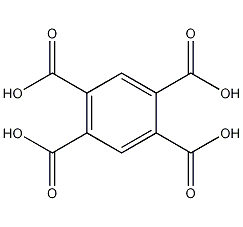
1,2,3,4-benzenetetracarboxylic acid

1,2,3,4-Benzenetetracarboxylic acid structural formula

1,2,3,4-benzenetetracarboxylic acid structural formula

structural formula

business number 020e
molecular formula c10h6o8
molecular weight 254.15
label

1,2,4,5-tetracarboxylic acid benzene,

pyromellitic acid,

pyromellitic acid,

pyromellitic acid,

c6h2(co2h)4

numbering system

cas number:89-05-4

mdl number:mfcd00002471

einecs number:201-879-5

rtecs number:db9275000

brn number:none

pubchem number:24891744

physical property data

1. properties: white to slightly yellow powdery crystal.

2. density (g/ml, 25/4℃): 1.79

3. melting point (ºc): undetermined

4. melting point (ºc) ): 276℃ (anhydrous), 242℃ (with 2 molecules of crystal water),

5. crystalline phase standard combustion heat (enthalpy) (kj·mol-1): -3244.02

6. crystal phase standard claims heat (enthalpy) (kj·mol-1): -1548.58

7. crystal phase phase standard combustion heat (enthalpy) (kj·mol-1): -3221.76

8. crystal phase standard claim heat (enthalpy) (kj·mol-1 ): -1570.84

9. specific rotation (º): undetermined

10. autoignition point or ignition temperature (ºc): undetermined

11. vapor pressure (kpa, 25ºc): undetermined

12. saturated vapor pressure (kpa, 60ºc): undetermined

13. heat of combustion (kj/ mol): undetermined

14. critical temperature (ºc): undetermined

15. critical pressure (kpa): undetermined

16. oil and water ( log value of the partition coefficient (octanol/water): undetermined

17. explosion upper limit (%, v/v): undetermined

18. explosion lower limit (%, v/ v): undetermined

19. solubility: easily soluble in alcohol, slightly soluble in ether and water. can be sublimated.

toxicological data

none

ecological data

none

molecular structure data

1. molar refractive index: 53.97

2. molar volume (cm3/mol): 139.5

3. isotonic specific volume (90.2k ): 455.7

4. surface tension (dyne/cm): 113.7

5. polarizability (10-24cm3): 21.39

computational chemistrydata

1. hydrophobic parameter calculation reference value (xlogp): 0

2. number of hydrogen bond donors: 4

3. number of hydrogen bond acceptors: 8

4. number of rotatable chemical bonds: 4

5. number of tautomers:

6. topological molecular polar surface area (tpsa): 149

7. number of heavy atoms: 18

8. surface charge: 0

9. complexity: 327

10. number of isotope atoms: 0

11. determine the number of atomic stereocenters: 0

12. uncertain number of atomic stereocenters: 0

13. determine the number of chemical bond stereocenters number: 0

14. number of uncertain chemical bond stereocenters: 0

15. number of covalent bond units: 1

properties and stability

none

storage method

this product should be stored in a sealed, cool and dry place.

synthesis method

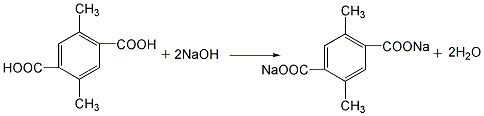
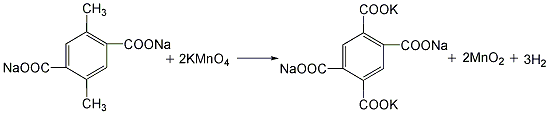
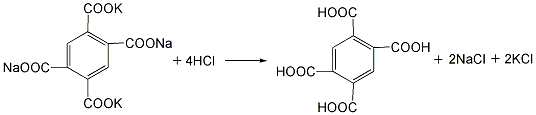
obtained from the oxidation of 1,2,4,5-tetramethylbenzene (or 5-isopropyl-1,2,4-trimethylbenzene), or from the chloromethylation and oxidation of xylene.

purpose

organic synthesis. epoxy resin hardener. intermediate of polyimide ester.

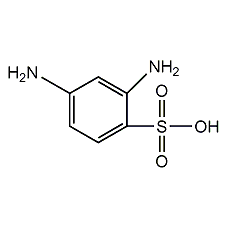
1,3-phenylenediamine-4-sulfonic acid

1,3-phenylenediamine-4-sulfonic acid structural formula

structural formula

business number 01zs
molecular formula c6h8n2o3s
molecular weight 188.20
label

m-diaminobenzene sulfonic acid,

2,4-diaminobenzenesulfonic acid,

2,4-diaminobenzenesulfonic acid,

aromatic sulfur compounds

numbering system

cas number:88-63-1

mdl number:mfcd00035772

einecs number:201-846-5

rtecs number:db5900000

brn number:2694057

pubchem number:24859688

physical property data

1. properties: light brown crystals, the crystals precipitated from water are monoclinic crystals.

2. solubility: easily soluble in hot water, slightly soluble in cold water, and gradually turns brown in the air.

toxicological data

highly toxic.

ecological data

none

molecular structure data

1. molar refractive index: 44.33

2. molar volume (cm3/mol): 116.7

3. isotonic specific volume (90.2k ): 356.1

4. surface tension (dyne/cm): 86.5

5. polarizability (10-24cm3): 17.57

compute chemical data

1. reference value for hydrophobic parameter calculation (xlogp): none

2. number of hydrogen bond donors: 3

3. number of hydrogen bond acceptors: 5

4. number of rotatable chemical bonds: 1

5. number of tautomers: none

6. topological molecule polar surface area 115

7. number of heavy atoms: 12

8. surface charge: 0

9. complexity: 246

10. number of isotope atoms: 0

11. determine the number of atomic stereocenters: 0

12. uncertain number of atomic stereocenters: 0

13. determine the number of chemical bond stereocenters: 0

14. number of uncertain chemical bond stereocenters: 0

15. number of covalent bond units: 1

properties and stability

inhalation of its vapor or absorption through the skin can cause poisoning. the workplace should be well ventilated and operators should wear protective equipment.

storage method

for its packaging, storage and transportation, please refer to m-aminobenzene sulfonic acid.

synthesis method

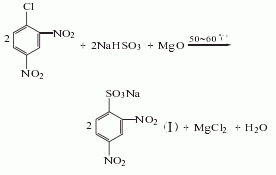
using 2,4-dinitrochlorobenzene as raw material, perform a sulfonation reaction with sodium bisulfite in the presence of magnesium oxide. after cooling, add hydrochloric acid to it becomes acidic, and 2,4-dinitrobenzene sulfonic acid is obtained by adding salt, cooling, letting it stand, suction filtration, and centrifugal dehydration. then put it into a reduction pot filled with iron filings and hydrochloric acid, boil it, neutralize it with na2co3, then add nahso3, let it stand, and filter it. the filtrate is concentrated, crystallized, and centrifuged to obtain the finished product

purpose

dye intermediates. mainly used to manufacture acid dyes, neutral dyes and various reactive dyes, such as acid medium brown rh, reactive bright yellow k-5g, reactive brilliant blue k-gr, neutral brilliant yellow s-5gl and other dyes.

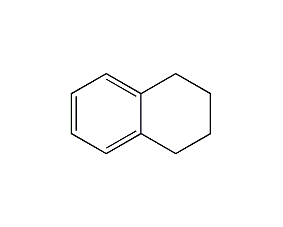
1,2,3,4-tetralin

1,2,3,4-tetralin structural formula

structural formula

business number 03b5
molecular formula c10h12
molecular weight 132
label

tetralin,

tetralin,

tetranap,

aromatic compounds

numbering system

cas number:119-64-2

mdl number:mfcd00001733

einecs number:204-340-2

rtecs number:qk3850000

brn number:1446407

pubchem number:24874115

physical property data

1. properties: colorless or light yellow transparent liquid with a menthol-like odor.

2. boiling point (ºc, 101.3kpa): 207.65

3. melting point (ºc): -35.75

4. relative density (g/ml, 20/4ºc): 0.9695

5. relative density (g/ml, 25/4ºc): 0.9660

6. refractive index (n20ºc): 1.5414

7. refractive index (n25ºc): 1.5392

8. viscosity (mpa·s, 20ºc): 2.02

9. viscosity (mpa·s, 50ºc): 1.3

p>

10. flash point (ºc, open): 75

11. flash point (ºc, closed): 71.6

12. fire point (ºc): 384

13. heat of evaporation (kj/mol, 206ºc): 45.6

14. heat of generation (kj/mol): -40.6

15. heat of combustion ( kj/(kg·k), constant volume): 5613.2

16. specific heat capacity (kj/(kg·k), 15~18ºc): 1.69

17. critical temperature ( ºc): 417.5

18. boiling point rising constant: 5.582

19. thermal conductivity (w/(m·k), 20≤t≤90 ºc): (153.1~ 0.22t)×10-3

20. explosion lower limit (%, v/v, 77.8ºc): 0.8

21. explosion upper limit (% , v/v, 121.8ºc): 5.0

22. volume expansion coefficient (k-1, 10~30ºc): 0.00083

23. dissolution properties: insoluble in water, miscible with most organic solvents such as ethanol, butanol, acetone, benzene, ether, chloroform, petroleum ether, decalin, etc.

24. critical pressure (mpa): 3.65

25. critical density (g·cm-3): 0.324

26. critical volume (cm3·mol-1): 408

27. critical compression factor: 0.249

28 .eccentricity factor: 0.328

29. solubility parameter (j·cm-3)0.5: 19.524

30. van der waals area (cm2·mol-1): 1.912×10⁹

31. van der waals volume (cm3·mol-1): 80.890

32. gas phase standard combustion heat (enthalpy) (kj·mol-1 ): -5676.77

33. the gas phase standard claims heat (enthalpy) (kj·mol-1): 26.65

34.�� phase standard entropy (j·mol-1·k-1): 366.25

35. gas phase standard formation free energy (kj·mol-1): 167.0

36. gas phase standard hot melt (j·mol-1·k-1): 150.94

37. liquid phase standard combustion heat (enthalpy) (kj·mol-1): -5621.54

38. liquid phase standard claimed heat ( enthalpy) (kj·mol-1): -28.58

39. liquid phase standard entropy (j·mol-1·k -1): 251.46

40. liquid phase standard free energy of formation (kj·mol-1): 147.03

41. liquid phase standard hot melt (j·mol-1·k-1): 234.7

toxicological data

1. irritation: rabbit transdermal: 500mg severe irritation

2. acute toxicity: rat oral ld50: 1620ul/kg

rabbit transdermal ld50: 17300ul/ kg

guinea pig inhaled lc50: 275ppm3, which is low toxic. it has anesthetic and local stimulating effects. inhaling the vapor can cause mild confusion, headache, nausea, vomiting, and coughing, and can irritate the conjunctiva and nasal and pharyngeal mucosa or cause rhinitis. inhalation of high concentrations can damage the liver and kidneys, and cause chemical pneumonitis and crystal opacity. skin contact may cause dermatitis. the olfactory threshold concentration is 0.018mg/l. tj 36-79 stipulates that the maximum allowable concentration in workshop air is 100mg/m3. the oral ld50 in rats is 2.9g/kg.

ecological data

harmful to water, harmful to fish and plankton.

molecular structure data

1. molar refractive index: 43.03

2. molar volume (cm3/mol): 136.2

3. isotonic specific volume (90.2k ): 333.5

4. surface tension (dyne/cm): 35.8

5. polarizability (10-24cm3): 17.06

compute chemical data

1. reference value for hydrophobic parameter calculation (xlogp): none

2. number of hydrogen bond donors: 0

3. number of hydrogen bond acceptors: 0

4. number of rotatable chemical bonds: 0

5. number of tautomers: none

6. topological molecule polar surface area 0

7. number of heavy atoms: 10

8. surface charge: 0

9. complexity: 92.6

10. number of isotope atoms: 0

11. determine the number of atomic stereocenters: 0

12. uncertain number of atomic stereocenters: 0

13. determine the number of chemical bond stereocenters: 0

14. number of uncertain chemical bond stereocenters: 0

15. number of covalent bond units: 1

properties and stability

1. avoid contact with strong oxidants, heat, air, and light. it is a flammable liquid and is non-corrosive to metals. due to the danger of explosion due to the production of peroxide, it should not be evaporated to dryness during distillation. insoluble in water, miscible with most organic solvents such as ethanol, butanol, acetone, benzene, ether, chloroform, petroleum ether, decalin and so on. dissolves 50.6% in methanol. in addition to hard glue, shellac, phenolic resin, and urea-formaldehyde resin, tetralin can dissolve most natural and synthetic resins such as rosin, coumarone resin, and alkyd resin. it can also dissolve asphalt, grease, vulcanized rubber, grease and cellulose ethers, but not cellulose esters. 2. halogenation and nitration reactions can occur to generate halogen and nitro derivatives. after oxidation by air or oxygen, peroxide is generated and gradually turns into a resinous substance. oxidation with potassium permanganate or nitric acid produces phthalic acid. phthalic anhydride is generated during gas phase oxidation using a vanadium catalyst. under nickel catalysis, hydrogenation produces decalin, and dehydrogenation produces naphthalene. aromatic hydrocarbons such as toluene and xylene are generated during thermal cracking. it reacts with alcohols and alkenes to produce an alkylation reaction on the benzene ring. when in contact with air for a long time, it absorbs oxygen in the air and generates hydroperoxide, which may cause explosion hazard. 3.it is not very toxic, has a certain anesthetic effect, and can cause headaches, discomfort and skin eczema. rat oral administration: ld502900mg/g. the allowable concentration in air is 0.05 mg/kg.
4. prolonged contact between tetralin and air can produce tetralin peroxide and cause an explosion. goggles, gas masks and rubber gloves must be worn during use.
5. exists in oriental tobacco leaves and smoke.
 

storage method

stored in a cool, ventilated warehouse. keep away from fire and water. keep away from light. should be kept away from oxidizer, do not store together. equipped with the appropriate variety and quantity of fire equipment. store in a sealed container. can be stored in iron, mild steel, copper or aluminum containers.

tetralin is a class iii flammable liquid and poses a fire hazard. it must be stored in a cool, ventilated place, away from heat sources and fires, and stored separately from oxidants. pack and unload with care to keep the packaging intact.

synthesis method

1. prepared from naphthalene through nickel-catalyzed selective hydrogenation. the gas phase catalytic reaction is carried out in an adiabatic reaction device, using a nickel molybdate catalyst at 300°c and 2.94mpa. the feeding space speed is 0.8h-1, the volume ratio of hydrogen and naphthalene is 2500-6400, and the single-pass conversion rate of naphthalene can reach 85 %, and the selectivity of tetralin is over 92%. after stripping and distillation of the hydrogenated product, the purity of tetralin reaches over 98%.

2. tobacco: or, 57 .

3. synthesis: extraction with pentane.

purpose

manadienol is used in large quantities as an intermediate in the manufacture of the insecticide divinyl. it is also used in the production of lubricants to reduce the viscosity of high-viscosity oils. it is widely used as a solvent for resins, waxes, greases, paints, and plastics to remove naphthalene deposits in gas industry equipment. mixed with alcohol and benzene as fuel for internal combustion engines. it is also used as a degreasing agent, softener, absorbent for low-boiling organic compound vapors, insect repellent and turpentine substitute. used as solvents for coatings, varnishes, metal soaps, chlorinated rubber, waxes, greases, resins, etc., ink detergents, liquid desiccants and the manufacture of reclaimed rubber.

it can be mixed with all organic solvents except water. it is a solvent with a wide range of dissolution, especially for oils and greases. therefore, it is used in cotton, rayon, and wool in the fiber industry. degreasing and washing. in addition, it has universal solubility in resin and can be used as a detergent to remove resin dirt.
the purity of naphthalene is over 98%.

2. tobacco: or, 57 .

3. synthesis: extraction with pentane.

purpose

manadienol is used in large quantities as an intermediate in the manufacture of the insecticide divinyl. it is also used in the production of lubricants to reduce the viscosity of high-viscosity oils. it is widely used as a solvent for resins, waxes, greases, paints, and plastics to remove naphthalene deposits in gas industry equipment. mixed with alcohol and benzene as fuel for internal combustion engines. it is also used as a degreasing agent, softener, absorbent for low-boiling organic compound vapors, insect repellent and turpentine substitute. used as solvents for coatings, varnishes, metal soaps, chlorinated rubber, waxes, greases, resins, etc., ink detergents, liquid desiccants and the manufacture of reclaimed rubber.

it can be mixed with all organic solvents except water. it is a solvent with a wide range of dissolution, especially for oils and greases. therefore, it is used in cotton, rayon, and wool in the fiber industry. degreasing and washing. in addition, it has universal solubility in resin and can be used as a detergent to remove resin dirt.
bdmaee:bis (2-dimethylaminoethyl) ether

cas no:3033-62-3

china supplier

for more information, please contact the following email:

email:sales@newtopchem.com

email:service@newtopchem.com

email:technical@newtopchem.com

BDMAEE Manufacture !