1,3-diphenyltriazene

1,3-diphenyltriazene structural formula

structural formula

business number 03qs
molecular formula c12h11n3
molecular weight 197.24
label

phenylaminodiazobenzene,

1,3-diphenyl-1-triazene,

diazoaminobenzene,

aniline azobenzene,

benzene azoamine,

aniline diazobenzene,

diazoaminobenzene,

foaming agent,

polymerization initiator,

accelerator for raw rubber

numbering system

cas number:136-35-6

mdl number:mfcd00003021

einecs number:diazoaminobenzene

rtecs number:xy2625000

brn number:none

pubchem number:24846930

physical property data

1. characteristics: golden yellow shiny scaly crystals with a special odor.

2. density (g/ml, 25/4℃): 1.17

3. relative vapor density (g/ml, air=1): undetermined 4. melting point (ºc): 96~98

5. boiling point (ºc, normal pressure): undetermined

6. boiling point (ºc, 20pa): 140

7. refractive index: undetermined8. flash point (ºc): undetermined 9. decomposition temperature (ºc): 103℃ in air, 95~100℃ in plastic 10. standard gas emission volume: 115ml/g11. solubility: easily dissolved in natural rubber and neoprene rubber , soluble in ethanol and ether, insoluble in water.

toxicological data

oncogenic data:

mouse oral tdlo: 1480mg/kg/59d-c

mouse transdermal tdlo: 30mg/kg/46w-i

mutation data:

bacteria-salmonella typhimurium: 300ng/plate

ecological data

none

molecular structure data

5. molecular property data:

1. molar refractive index: 61.91

2. molar volume (cm3/mol): 182.8

3. isotonic specific volume (90.2k): 467.3

4. surface tension (dyne/cm): 42.6

5. polarizability (10-24cm3): 24.54

compute chemical data

1. reference value for hydrophobic parameter calculation (xlogp): 4

2. number of hydrogen bond donors: 1

3. number of hydrogen bond acceptors: 3

4. number of rotatable chemical bonds: 3

5. number of tautomers: none

6. topological molecule polar surface area 36.8

7. number of heavy atoms: 15

8. surface charge: 0

9. complexity: 191

10. number of isotope atoms: 0

11. number of determined atomic stereocenters: 0

12. uncertain atoms number of stereocenters: 0

13. determine the number of stereocenters of chemical bonds: 0

14. uncertain number of stereocenters of chemical bonds: 0

15. number of covalent bond units: 1

properties and stability

storage stable. non-toxic. it will decompose at lower temperatures in acidic media, and the decomposition products are harmful to the human body. production equipment should be sealed, and ventilation and exhaust should be strengthened at the production site. operators should wear protective equipment.

storage method

should be sealed and stored in a ventilated, cool, dry place, and be protected from moisture and heat. it cannot be stored or transported together with acid or acidic substances.

synthesis method

put aniline and azobenzene chloride into the reactor at a mass ratio of 1:1.46, add water and stir to dissolve, then add an appropriate amount of sodium acetate as a catalyst, raise the temperature to 35°c, react with stirring for 1 hour, and then heat the temperature was raised to 65°c and reacted for 6 hours. the hydrogen chloride gas generated during the reaction is absorbed with water to obtain hydrochloric acid as a by-product. after the reaction solution is allowed to stand for 10 hours, sodium chloride is added to salt out to precipitate azoaminobenzene, and then is filtered and dried at low temperature to obtain the finished product.

purpose

complex titration indicator. precipitating agent for palladium and copper. determination of palladium and copper and separation from other ions. this product is used as a foaming agent for various rubbers and resins. such as polyvinyl chloride and its copolymers, polystyrene, polyethylene, phenolic resin, epoxy resin, raw rubber and rubber, silicone polymers, etc. the dosage is 0.1%~5.0%. this product is also used as a polymerization initiator and accelerator for raw rubber.
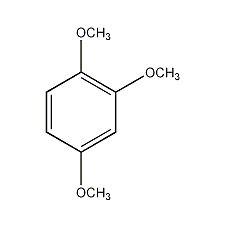
1,2,4-trimethoxybenzene

1,2,4-trimethoxybenzene structural formula

1,2,4-trimethoxybenzene structural formula

structural formula

business number 03qk
molecular formula c9h12o3
molecular weight 168.19
label

hydroxyhydroquinone trimethyl ether,

aromatic compounds

numbering system

cas number:135-77-3

mdl number:mfcd00008360

einecs number:205-219-7

rtecs number:none

brn number:2047579

pubchem number:24900410

physical property data

none

toxicological data

none

ecological data

none

molecular structure data

molecular property data:

1 molar refractive index46.28

2 molar volume(m3/mol):161.4

3 isotonic specific volume90.2k):377.2

4 surface tension(3.0 dyne/cm):29.8

5 polarizability0.5 10-24 cm3):18.35

compute chemical data

1. reference value for hydrophobic parameter calculation (xlogp): none

2. number of hydrogen bond donors: 0

3. number of hydrogen bond acceptors: 3

4. number of rotatable chemical bonds: 3

5. number of tautomers: none

6. topological molecule polar surface area 27.7

7. number of heavy atoms: 12

8. surface charge: 0

9. complexity: 127

10. number of isotope atoms: 0

11. determine the number of atomic stereocenters: 0

12. uncertain number of atomic stereocenters: 0

13. determine the number of chemical bond stereocenters: 0

14. number of uncertain chemical bond stereocenters: 0

15. number of covalent bond units: 1

properties and stability

liquid. boiling point 247℃, relative density 1.106, refractive index 1.5330, flash point >110℃

storage method

none

synthesis method

oxidize vanillin with hydrogen peroxide, then hydrolyze, and methylate it with dimethyl sulfate; or use hydroquinone to oxidize it with sodium dichromate and sulfuric acid to generate terequinone, which is prepared with acetic anhydride. acetylation yields 1,2,4-phloroglucinol triacetate, which is obtained by methylation with dimethyl sulfate.

purpose

intermediates of leucine.

1. reference value for hydrophobic parameter calculation (xlogp): none

2. number of hydrogen bond donors: 0

3. number of hydrogen bond acceptors: 3

4. number of rotatable chemical bonds: 3

5. number of tautomers: none

6. topological molecule polar surface area 27.7

7. number of heavy atoms: 12

8. surface charge: 0

9. complexity: 127

10. number of isotope atoms: 0

11. determine the number of atomic stereocenters: 0

12. uncertain number of atomic stereocenters: 0

13. determine the number of chemical bond stereocenters: 0

14. number of uncertain chemical bond stereocenters: 0

15. number of covalent bond units: 1

properties and stability

liquid. boiling point 247℃, relative density 1.106, refractive index 1.5330, flash point >110℃

storage method

none

synthesis method

oxidize vanillin with hydrogen peroxide, then hydrolyze, and methylate it with dimethyl sulfate; or use hydroquinone to oxidize it with sodium dichromate and sulfuric acid to generate terequinone, which is prepared with acetic anhydride. acetylation yields 1,2,4-phloroglucinol triacetate, which is obtained by methylation with dimethyl sulfate.

purpose

intermediates of leucine.

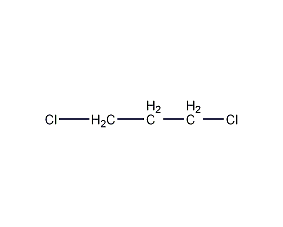
1,3-dichloropropane

1,3-dichloropropane structural formula

1,3-dichloropropane structural formula

structural formula

business number 03ux
molecular formula c3h6cl2
molecular weight 112.99
label

dichlorotrimethylene,

trimethylene chloride,

trimethylene dichloride,

1,3-propylenechloride,

chromatographic material reference material,

detergent,

halogenated hydrocarbon solvents

numbering system

cas number:142-28-9

mdl number:mfcd00000999

einecs number:205-531-3

rtecs number:tx9660000

brn number:none

pubchem id:none

physical property data

1. properties: colorless liquid with an odor similar to chloroform. [1]

2. melting point (℃): -99.5[2]

3. boiling point (℃): 120~122[3]

4. relative density (water=1): 1.20[4]

5. relative vapor density (air=1): 3.9[5]

6. saturated vapor pressure (kpa): 2.4 (20℃)[6]

7. heat of combustion (kj/mol): -1751.8[7]

8. critical pressure (mpa): 4.23[ 8]

9. octanol/water partition coefficient: 2.0[9]

10. flash point (℃): 15.6 ( oc); 21 (cc) [10]

11. explosion upper limit (%): 14.5[11]

12. lower explosion limit (%): 3.4[12]

13. solubility: slightly soluble in water, easily soluble in most organic solvents such as ethanol and ether. [13]

14. relative density (25℃, 4℃): 1.1818

15. refractive index at room temperature (n25): 1.4460

16. solubility parameter (j·cm-3)0.5: 19.819

17. van der waals area (cm2·mol-1): 7.650×10⁹

18. van der waals volume (cm3·mol-1): 53.930

19. the gas phase standard claims heat (enthalpy) (kj·mol-1 ): -159.2

20. liquid phase standard claims heat (enthalpy) (kj·mol-1): -200.0

21 .liquid phase standard hot melt (j·mol-1·k-1): 149.6

toxicological data

1. acute toxicity[14] ld50: 3600mg/kg (mouse, exposure route unknown)

2. irritation no data available

3. mutagenicity[15] microbial mutagenicity: salmonella typhimurium 10 μmol/dish. micronucleus test: human lymphocytes 500 μmol/l. dna damage: human lymphocytes 500 μmol/l. sister chromatid exchange: hamster lung 6600 μmol/l.

ecological data

1. ecotoxicity[16]

lc50: 84ppm (7d) (guppy); 86.7 mg/l (96h) (red bass); 131mg/l (96h) (fathead minnow); 282mg/l (96h) (water fleas); 10.3mg/l (96h) (sugar shrimp)��

ec50: 72.2mg/l (96h) (green algae)

2. biodegradability no data yet

3. non-biodegradability[17]

in the air, when the hydroxyl radical concentration is 5.00×10 5 pieces/cm3, the degradation half-life is 21 days (theoretical).

when the ph value is 7 and the temperature is 25°c, the hydrolysis half-life is 2.3a (theoretical).

4. other harmful effects[18] this substance is harmful to the environment and can cause pollution to water bodies, especially bioaccumulation occurs in aquatic organisms.

molecular structure data

1. molar refractive index: 25.64

2. molar volume (cm3/mol): 100.8

3. isotonic specific volume (90.2k ): 228.3

4. surface tension (dyne/cm): 26.3

5. polarizability (10-24cm3): 10.16

compute chemical data

1. reference value for hydrophobic parameter calculation (xlogp): none

2. number of hydrogen bond donors: 0

3. number of hydrogen bond acceptors: 0

4. number of rotatable chemical bonds: 2

5. number of tautomers: none

6. topological molecule polar surface area 0

7. number of heavy atoms: 5

8. surface charge: 0

9. complexity: 12.4

10. number of isotope atoms: 0

11. determine the number of atomic stereocenters: 0

12. uncertain number of atomic stereocenters: 0

13. determine the number of chemical bond stereocenters: 0

14. number of uncertain chemical bond stereocenters: 0

15. number of covalent bond units: 1

properties and stability

1. it is flammable when exposed to open flames or high heat. it decomposes when heated to release highly toxic phosgene. it can react with oxidants.

2. stability[19] stable

3. incompatible substances[20] strong oxidants, acids, alkalis, aluminum

4. conditions to avoid contact[21] heating

5. polymerization hazard[22] no polymerization

6. decomposition products[23] hydrogen chloride, phosgene

storage method

storage precautions[24] stored in a cool, ventilated warehouse. keep away from fire and heat sources. the storage temperature should not exceed 37°c. keep container tightly sealed. they should be stored separately from oxidants, acids, alkalis, etc. and avoid mixed storage. use explosion-proof lighting and ventilation facilities. it is prohibited to use mechanical equipment and tools that are prone to sparks. the storage area should be equipped with emergency release equipment and suitable containment materials.

synthesis method

originated from the reaction of propylene glycol and hydrochloric acid.

purpose

1. used as organic synthesis intermediates and solvents.

2. used in organic synthesis, making detergents, and also used as solvents. [25]

1,3-dihydroxynaphthalene

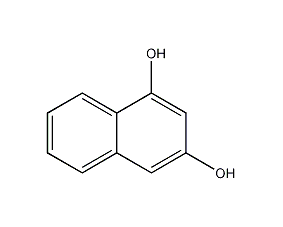
1,3-dihydroxynaphthalene structural formula

1,3-dihydroxynaphthalene structural formula

structural formula

business number 03ns
molecular formula c10h8o2
molecular weight 160.17
label

1,3-naphthalenediol,

naphthoresorbinol,

aromatic compounds

numbering system

cas number:132-86-5

mdl number:mfcd00003965

einecs number:205-079-7

rtecs number:qj4725000

brn number:2044002

pubchem number:24897775

physical property data

none yet

toxicological data

mutagenicity data:

bacteriasalmonella typhimurium: 250umol/l

bacteriasalmonella typhimurium: 625nmol/plate

ecological data

none yet

molecular structure data

5. molecular property data:

1 molar refractive index47.85

2 molar volume(m3/mol) :120.4

3 isotonic specific volume90.2k):341.1

4 surface tension(3.0 dyne/cm):64.4

5 polarizability0.5 10-24 cm3):18.97

compute chemical data

1. reference value for hydrophobic parameter calculation (xlogp): none

2. number of hydrogen bond donors: 2

3. number of hydrogen bond acceptors: 2

4. number of rotatable chemical bonds: 0

5. number of tautomers: 15

6. topological molecule polar surface area 40.5

7. number of heavy atoms: 12

8. surface charge: 0

9. complexity: 158

10. number of isotope atoms: 0

11. determine the number of atomic stereocenters: 0

12. uncertain number of atomic stereocenters: 0

13. determine the number of chemical bond stereocenters: 0

14. number of uncertain chemical bond stereocenters: 0

15. number of covalent bond units: 1

properties and stability

basic properties

pink to yellow leaf-like crystals. melting point 124-125℃, easily soluble in water, alcohol and ether.

storage method

none yet

synthesis method

brief description of production methods

decarboxylated from 1,3-dihydroxy-2-naphthoic acid

purpose

purpose

sugar and oil reagent for measuring glucuronic acid in urine.

t-font-family: arial; mso-font-kerning: 0pt”>(0.5 10 -24cm3):18.97

compute chemical data

1. reference value for hydrophobic parameter calculation (xlogp): none

2. number of hydrogen bond donors: 2

3. number of hydrogen bond acceptors: 2

4. number of rotatable chemical bonds: 0

5. number of tautomers: 15

6. topological molecule polar surface area 40.5

7. number of heavy atoms: 12

8. surface charge: 0

9. complexity: 158

10. number of isotope atoms: 0

11. determine the number of atomic stereocenters: 0

12. uncertain number of atomic stereocenters: 0

13. determine the number of chemical bond stereocenters: 0

14. number of uncertain chemical bond stereocenters: 0

15. number of covalent bond units: 1

properties and stability

basic properties

pink to yellow leaf-like crystals. melting point 124-125℃, easily soluble in water, alcohol and ether.

storage method

none yet

synthesis method

brief description of production methods

decarboxylated from 1,3-dihydroxy-2-naphthoic acid

purpose

purpose

sugar and oil reagent for measuring glucuronic acid in urine.

p-tert-octylphenol p-(1,1,3,3-tetramethylbutyl)phenol

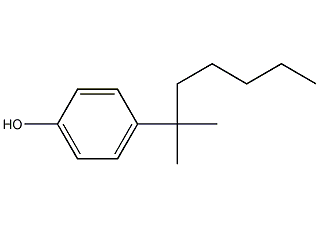
Structural formula of p-tert-octylphenol

structural formula of p-tert-octylphenol

structural formula

business number 03t6
molecular formula c14h22o
molecular weight 206.32
label

4-(1,1,3,3-tetramethylbutyl)phenol,

octylphenol,

4-(tert-octyl)phenol,

4-(1,1,3,3-tetramethylbutyl)-pheno,

aromatic compounds

numbering system

cas number:140-66-9

mdl number:mfcd00002368

einecs number:205-426-2

rtecs number:sm9625000

brn number:513992

pubchem number:24857490

physical property data

1. physical property data

1. characteristics: white flaky crystal

2. density (g/ml,25/4):0.889

3. melting point (ºc):83 ºc

4. boiling point (ºc,normal pressure):279 ºc

5. flashpoint (ºc): 138 ºc

6. solubility: insoluble in water, soluble in ethanol, toluene, acetone and other organic solvents.

toxicological data

2. toxicological data:

1, acute toxicity: rat oral ld50: 4600 mg/kg;

orally administered to mice ld50 : 3210 mg/kg;

rabbit skinld50: 1880 mg/kg.

ecological data

3. ecological data:

1, other harmful effects: this substance may be harmful to the environment, special attention should be paid to water bodies. span>

molecular structure data

5. molecular property data:

1. molar refractive index:65.05

2. molar volume (m3/ mol):220.5

3. isotonic specific volume (90.2k): orally administered to mice ld503210 mg/kg;

rabbit skinld50: 1880 mg/kg.

ecological data

3. ecological data:

1, other harmful effects: this substance may be harmful to the environment, special attention should be paid to water bodies. span>

molecular structure data

5. molecular property data:

1. molar refractive index:65.05

2. molar volume (m3/ mol):220.5

3. isotonic specific volume (90.2k): 529.4

4. surface tension (dyne/cm): 33.1

5. polarizability10-24cm3):25.78

compute chemical data

1. reference value for hydrophobic parameter calculation (xlogp): none

2. number of hydrogen bond donors: 1

3. number of hydrogen bond acceptors: 1

4. number of rotatable chemical bonds: 3

5. number of tautomers: 2

6. topological molecule polar surface area 20.2

7. number of heavy atoms: 15

8. surface charge: 0

9. complexity: 192

10. number of isotope atoms: 0

11. determine the number of atomic stereocenters: 0

12. uncertain number of atomic stereocenters: 0

13. determine the number of chemical bond stereocenters: 0

14. number of uncertain chemical bond stereocenters: 0

15. number of covalent bond units: 1

properties and stability

stable under normal temperature and pressure. span>

storage method

stored sealed in a dry and cool place.

synthesis method

none yet

purpose

1. widely used in the manufacture of oil-soluble phenolic resins, surfactants, adhesives, etc.

2.for the production of octyl phenol polyoxyethylene ethers and octylphenol formaldehyde resin is also widely used as nonionic surfactant, textile auxiliary, oil field auxiliary, and antioxidant raw materials for agents and rubber vulcanizers. span>

le=”font-size: 9pt; font-family: ‘arial’,’sans-serif'”>529.4

4. surface tension (dyne/cm): 33.1

5. polarizability10-24cm3):25.78

compute chemical data

1. reference value for hydrophobic parameter calculation (xlogp): none

2. number of hydrogen bond donors: 1

3. number of hydrogen bond acceptors: 1

4. number of rotatable chemical bonds: 3

5. number of tautomers: 2

6. topological molecule polar surface area 20.2

7. number of heavy atoms: 15

8. surface charge: 0

9. complexity: 192

10. number of isotope atoms: 0

11. determine the number of atomic stereocenters: 0

12. uncertain number of atomic stereocenters: 0

13. determine the number of chemical bond stereocenters: 0

14. number of uncertain chemical bond stereocenters: 0

15. number of covalent bond units: 1

properties and stability

stable under normal temperature and pressure. span>

storage method

stored sealed in a dry and cool place.

synthesis method

none yet

purpose

1. widely used in the manufacture of oil-soluble phenolic resins, surfactants, adhesives, etc.

2.for the production of octyl phenol polyoxyethylene ethers and octylphenol formaldehyde resin is also widely used as nonionic surfactant, textile auxiliary, oil field auxiliary, and antioxidant raw materials for agents and rubber vulcanizers. span>

1,4-naphthoquinone 1,4-naphthoquinone

1,4-naphthoquinone structural formula

structural formula

business number 03md
molecular formula c10h6o2
molecular weight 158
label

1,4-naphthalenedione,

α-naphthoquinone,

1,4-naphthoquinone,

1,2-naphthalenedione,

beta-naphthoquinone,

1,4-naphthoquinone,

1,4-naphthoquinone,

p-naphthoquinone,

α-naphthoquinone

numbering system

cas number:130-15-4

mdl number:mfcd00001676

einecs number:204-977-6

rtecs number:ql7175000

brn number:878524

pubchem number:24858619

physical property data

1. properties: bright yellow needle-like crystals. it can evaporate with water vapor and has the smell of benzoquinone.

2. density (g/ml, 25/4℃): 1.422

3. melting point (℃): 128.5

4. solubility: easy soluble in hot ethanol, ether, benzene, chloroform, carbon disulfide and acetic acid, soluble in alkaline hydroxide solution, slightly soluble in petroleum ether, and a small amount soluble in cold water.

toxicological data

none yet

ecological data

none yet

molecular structure data

1. molar refractive index: 42.90

2. molar volume (cm3/mol): 122.5

3. isotonic specific volume (90.2k ): 330.5

4. surface tension (dyne/cm): 52.9

5. polarizability (10-24cm3): 17.00

compute chemical data

1. reference value for hydrophobic parameter calculation (xlogp): none

2. number of hydrogen bond donors: 0

3. number of hydrogen bond acceptors: 2

4. number of rotatable chemical bonds: 0

5. number of tautomers: none

6. topological molecule polar surface area 34.1

7. number of heavy atoms: 12

8. surface charge: 0

9. complexity: 227

10. number of isotope atoms: 0

11. determine the number of atomic stereocenters: 0

12. uncertain number of atomic stereocenters: 0

13. determine the number of chemical bond stereocenters: 0

14. number of uncertain chemical bond stereocenters: 0

15. number of covalent bond units: 1

properties and stability

1. toxic and irritating.

2. it can be sublimated by heating to 100℃. strong heating can decompose and explode.

storage method

none yet

synthesis method

using 1-naphthol, 1-naphthylamine, 1,4-aminonaphthol, naphthalene, etc. as raw materials, naphthoquinone can be obtained through oxidation. the oxidizing agent can be chromic anhydride, sodium dichromate, potassium dichromate, air, etc. an industrially more advantageous method is to produce naphthoquinone by catalytic oxidation of naphthalene in the presence of barium pentoxide.

purpose

1. used for anthraquinoneproperty. 2,3-dichloronaphthoquinone produced by the chlorination reaction of naphthoquinone is an important agricultural fungicide, used to control wheat smut, rice blast, potato late blight and damping off of vegetable seedlings.

2. mainly used as dienophile to prepare various aromatic ring compounds through diels-alder cycloaddition reaction. it can also realize amination reaction, allylation reaction, cyclooligomerization reaction and thiele-winter acetation reaction produces other types of aromatic compounds.

due to the electron-withdrawing effect of the two carbonyl groups at the 1-position and 4-position, 1,4-naphthoquinone is a very effective dienophile and can react with electronegative diene compounds. -alder cycloaddition reaction to obtain benzo polycyclic compounds. such as the cycloaddition reaction with benzofuran to prepare tetracenequinone (formula 1)[1], or the reaction with 2,3-vinyl indole to prepare pentacene (formula 2)[2].

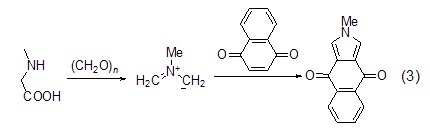
1,4-naphthoquinone also a new method is provided for the synthesis of 2h-isoindole-4,7-dione (formula 3)[3].

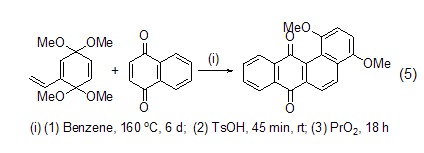
in the synthesis of biologically active compounds on the other hand, 1,4-naphthoquinone also plays a very important role. for example, the reaction with pyrrole provides a good precursor for the preparation of antibiotics (formula 4)[4], and the diels-alder reaction with vinylquinone acetal is used to synthesize non-linear benzopolycyclic rings. antibiotics provide a good method (formula 5)[5].

allyl cyanide can also undergo cycloaddition reaction with 1,4-naphthoquinone (formula 6)[6]. 3-alkenylpyrrole as a diene can also react with 1,4-naphthoquinone to obtain indole compounds (formula 7)[7].

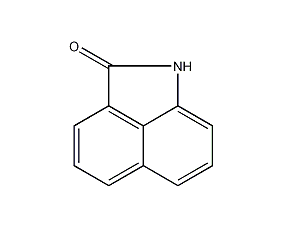
1,8-naphthalene lactimide benzo[cd]indol-2(1h)-one

1,8-naphthalene lactimide structural formula

1,8-naphthalene lactimide structural formula

structural formula

business number 03ma
molecular formula c11h7no
molecular weight 169.18
label

naphthalimide,

1,2-dihydrobenzo[cd]indol-2-one,

1,8-naphtholactam,

aromatic compounds

numbering system

cas number:130-00-7

mdl number:mfcd00009748

einecs number:204-973-4

rtecs number:de3202000

brn number:none

pubchem number:24860382

physical property data

1. properties: fine needle crystals

2. melting point (℃): 181

3. solubility: soluble in boiling water, insoluble in ether.

toxicological data

1. acute toxicity: unknown mammalian ld5o: 2700mg/kg

mouse oral ld5o: 1gm/kg

2. other multiple dose toxicity: rat oral tdlo: 4200mg/kg/14d-i

ecological data

none yet

molecular structure data

1. molar refractive index: 50.52

2. molar volume (cm3/mol): 127.4

3. isotonic specific volume (90.2k ): 350.7

4. surface tension (dyne/cm): 57.3

5. polarizability (10-24cm3): 20.02

compute chemical data

1. reference value for hydrophobic parameter calculation (xlogp): 2.1

2. number of hydrogen bond donors: 1

3. number of hydrogen bond acceptors: 1

4. number of rotatable chemical bonds: 0

5. number of tautomers: 2

6. topological molecule polar surface area 29.1

7. number of heavy atoms: 13

8. surface charge: 0

9. complexity: 238

10. number of isotope atoms: 0

11. determine the number of atomic stereocenters: 0

12. uncertain number of atomic stereocenters: 0

13. determine the number of chemical bond stereocenters: 0

14. number of uncertain chemical bond stereocenters: 0

15. number of covalent bond units: 1

properties and stability

none yet

storage method

none yet

synthesis method

derived from rearrangement of 1,8-naphthalenedicarboximide. add water, sodium hydroxide solution and caustic potassium solution to the reaction pot, add sodium hypochlorite and diffusing agent nno while stirring, add 1,8-naphthalenedicarboximide at 30°c, and keep it at 28-30°c for 2.5 hours. maintain an excess of sodium hypochlorite during the reaction. after the heat preservation is completed, use sodium bisulfite to eliminate excess sodium hypochlorite, and use hydrochloric acid to adjust to 9.5-10. filter out the unreacted naphthalene diimide, and precipitate the filtrate with hydrochloric acid until the ph is 2-3 at a temperature below 40°c. heat to 80-85°c, keep warm for half an hour, and close the loop. cool to 60°c, filter and wash to obtain 1,8-naphthalene lactimide.

purpose

dye intermediates. used to synthesize perylene dyes and pigments, such as reduced gray bg, reduced brilliant orange 3rk, soluble anthracene brilliant orange irk, etc.

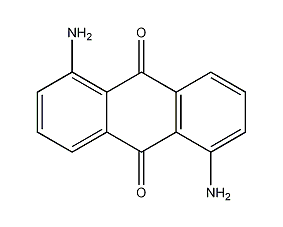
1,5-diaminoanthraquinone 1,5-diaminoanthraquinone

1,5-diaminanthraquinone structural formula

1,5-diaminanthraquinone structural formula

structural formula

business number 03lz
molecular formula c14h10n2o2
molecular weight 238.25
label

1,5-diamine enquinsulfonic acid,

1,5-diamino-9,10-anthraquinone,

aromatic compounds

numbering system

cas number:129-44-2

mdl number:mfcd00001226

einecs number:204-947-2

rtecs number:cb6400000

brn number:none

pubchem number:24862850

physical property data

1. properties: dark red needle crystals (in ethanol, acetic acid).

2. melting point (decomposition, ℃): 308

3. solubility: soluble in hot nitrobenzene, slightly soluble in ethanol, ether, benzene, acetone, and chloroform. the solution in concentrated sulfuric acid is almost colorless.

toxicological data

1. skin/eye irritation: rabbit eye standard drez eye dye test: 500mg/24h has a slight irritating effect on the eyes.

2. acute toxicity: rat transperitoneal ld5o: 1300mg/kg

3. mutagenicity: salmonella gene mutation testing system: 500ug/plate

ecological data

none yet

molecular structure data

1. molar refractive index: 67.14

2. molar volume (cm3/mol): 163.6

3. isotonic specific volume (90.2k ): 490.7

4. surface tension (dyne/cm): 80.9

5. polarizability (10-24cm3): 26.61

compute chemical data

1. reference value for hydrophobic parameter calculation (xlogp): 2.6

2. number of hydrogen bond donors: 2

3. number of hydrogen bond acceptors: 4

4. number of rotatable chemical bonds: 0

5. number of tautomers: 15

6. topological molecule polar surface area 86.2

7. number of heavy atoms: 18

8. surface charge: 0

9. complexity: 346

10. number of isotope atoms: 0

11. determine the number of atomic stereocenters: 0

12. uncertain number of atomic stereocenters: 0

13. determine the number of chemical bond stereocenters: 0

14. number of uncertain chemical bond stereocenters: 0

15. number of covalent bond units: 1

properties and stability

basic properties

red-brown needle-like crystals. melting point 319℃. soluble in hot nitrobenzene, slightly soluble in ethanol, ether, benzene, chloroform and acetone, insoluble in water. heating and sublimation.

storage method

none yet

synthesis method

the nitrification reduction method is mainly used. anthraquinone is used as raw material. it is nitrated with mixed acid in concentrated sulfuric acid to obtain 1,5-dinitroanthraquinone and 1,8-diaminanthraquinone. after filtering and washing, they are then reduced with sodium sulfide, and then obtained by filtering, washing and drying.

purpose

dye intermediates. mainly used to prepare anthraquinone reduction dyes reduction yellow 3rt, reduction orange 3g, reduction orange 3c, reduction gray 3y, and other anthraquinone dyes such as��lan et al.

1,4,5,8-naphthalenetetracarboxylic acid 1,4,5,8-naphthalenetetracarboxylic acid

structural formula

business number 03lv
molecular formula c14h8o8
molecular weight 304.21
label

naphthalene tetracarboxylic acid,

1,4,5,8-naphthalenetetracarboxylic acid,

naphthalene-1,4,5,8-tetracarboxylic acid,

aromatic compounds

numbering system

cas number:128-97-2

mdl number:mfcd00004012

einecs number:none

rtecs number:qk3690000

brn number:none

pubchem id:none

physical property data

1. properties: white crystal

2. solubility: slightly soluble in water and hot acetic acid, soluble in acetone aqueous solution, very slightly soluble in benzene, chloroform, carbon disulfide and ethanol.

toxicological data

1. acute toxicity: rat oral ld5o: 7500mg/kg

mouse oral ld5o: 3800mg/kg

ecological data

none yet

molecular structure data

1. molar refractive index: 71.81

2. molar volume (cm3/mol): 173.6

3. isotonic specific volume (90.2k ): 559.6

4. surface tension (dyne/cm): 107.8

5. polarizability (10-24cm3): 28.46

compute chemical data

1. reference value for hydrophobic parameter calculation (xlogp): 1.3

2. number of hydrogen bond donors: 4

3. number of hydrogen bond acceptors: 8

4. number of rotatable chemical bonds: 4

5. number of tautomers: none

6. topological molecule polar surface area 149

7. number of heavy atoms: 22

8. surface charge: 0

9. complexity: 423

10. number of isotope atoms: 0

11. determine the number of atomic stereocenters: 0

12. uncertain number of atomic stereocenters: 0

13. determine the number of chemical bond stereocenters: 0

14. number of uncertain chemical bond stereocenters: 0

15. number of covalent bond units: 1

properties and stability

low toxicity. it has a slightly sour smell and will not harm human health as long as the working environment is well ventilated. in the process of producing naphthalenetetracarboxylic acid, whether pyrene fraction or acenaphthene is used as raw material, they are toxic substances.

storage method

none yet

synthesis method

1. pyrene method: using pyrene as raw material, it is obtained through chlorination and oxidation.

2. acenaphthene method this method includes propylene glycol method and carbamoyl chloride method.

(1) propylene chloride method: dissolve the cyanoacetic acid amide obtained by cyanidation, ammoniation and dehydration of chloroacetic acid in chlorobenzene, react with phosphorus pentachloride to obtain propylene chloride, theoretically the yield is 77%. add malonite and an equal amount of acenaphthene to chlorobenzene, add aluminum trichloride, and pass in hydrogen chloride at the same time, and heat the reaction to obtain diiminoketone with a theoretical yield of 89%. oxidize the diiminoketone with sodium hypochlorite and potassium permanganate to obtain 1,4,5,8-naphthalenetetracarboxylic acid. the theoretical yield is 51.8%.

(2) carbamoyl chloride method in the presence of aluminum trichloride, acenaphthene and carbamoyl chloride are heated in chlorobenzene to react. reaction�first acidify with concentrated hydrochloric acid, and then hydrolyze with sodium hydroxide to obtain 5,6-acenaphthylenedicarboxylic acid, with a yield of 63%. 5,6-acenaphthylenedicarboxylic acid is further oxidized to obtain 1,4,5,8-acenaphthylenetetracarboxylic acid, with a yield of 60%.

purpose

dye intermediates. it can be used to produce dyes such as vat orange gr. the plastics industry is used to manufacture new resins—polyimide and tnm polymers—that have good insulation, radiation resistance, and can withstand high temperatures (400°c).

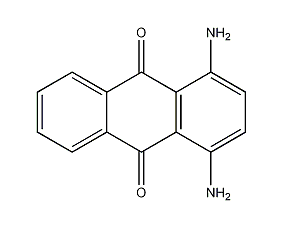
1,4-diaminoanthraquinone 1,4-diaminoanthraquinone

1,4-diaminanthraquinone structural formula

structural formula

business number 03lu
molecular formula c14h10n2o2
molecular weight 238.25
label

1,4-diamino-9,10-anthracenedione,

1,4-diaminoanthraquinone (oxide form),

dunant purple 2r,

anthraquinone-1,4-diamine,

sudan purple,

1,4-diamino-10-anthracenedione,

1,4-diamino-9,10-anthracenedione,

1,4-diamino-9,10-anthraquinone,

aromatic nitrogen-containing compounds and their derivatives

numbering system

cas number:128-95-0

mdl number:mfcd00001224

einecs number:204-922-6

rtecs number:cb6300000

brn number:2216556

pubchem number:24862847

physical property data

1. properties: dark purple crystal (in pyridine) or purple crystal.

2. melting point (℃): 268

3. solubility: soluble in benzene, pyridine, nitrobenzene, aniline, slightly soluble in hot acetic acid and ethanol. the solution in concentrated sulfuric acid is almost colorless, and becomes blue-red after adding boric acid.

toxicological data

1. skin/eye irritation: rabbit eye standard drez eye dye test: 500mg/24h has a slight irritating effect on the eyes.

2. acute toxicity: rat oral ld5o: 5790mg/kg

rat peritoneal ld5o: 250mg/kg

3. mutagenicity: salmonella gene mutation testing system: 100ug/plate

microbial gene mutation testing system: 12800ug/l

ecological data

none yet

molecular structure data

1. molar refractive index: 67.14

2. molar volume (cm3/mol): 163.6

3. isotonic specific volume (90.2k ): 490.7

4. surface tension (dyne/cm): 80.9

5. polarizability (10-24cm3): 26.61

compute chemical data

1. reference value for hydrophobic parameter calculation (xlogp): 2.6

2. number of hydrogen bond donors: 2

3. number of hydrogen bond acceptors: 4

4. number of rotatable chemical bonds: 0

5. number of tautomers: 8

6. topological molecule polar surface area 86.2

7. number of heavy atoms: 18

8. surface charge: 0

9. complexity: 346

10. number of isotope atoms: 0

11. determine the number of atomic stereocenters: 0

12. uncertain number of atomic stereocenters: 0

13. determine the number of chemical bond stereocenters: 0

14. number of uncertain chemical bond stereocenters: 0

15. number of covalent bond units: 1

properties and stability

1.basic properties

dark purple needle-like crystals. melting point 268℃. soluble in ethanol, benzene and nitrobenzene, slightly soluble in water and hot acetic acid.

2.�body ld1~2g/kg. rats were intraperitoneally injected with ld100500mg/kg. see 1,5-diaminanthraquinone.
 

storage method

packed in iron drums lined with plastic bags, net weight per drum is 50kg. store in a ventilated place, protected from sun and moisture.

synthesis method

brief description of the production method

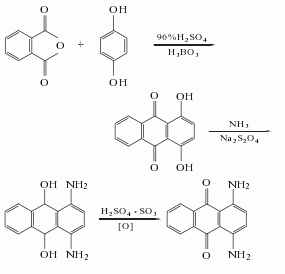
1,4-dihydroxyanthraquinone is obtained by condensation of hydroquinone and phthalic anhydride, and then ammoniated to obtain 1,4-diaminoanthraquinone leuco body, which is then oxidized with fuming sulfuric acid. raw material consumption quota: phthalic anhydride 2131kg/t, hydroquinone 887kg/t, ammonia (20%) 10788kg/t, oleum 3580kg/t.

purpose

mainly used to prepare anthraquinone series vat dyes, disperse dyes, acid dyes, etc., such as vat olive r, vat brown br, disperse violet h-frl, disperse emerald blue h-gl and other dyes. it can be used by itself as a disperse violet dye.

bdmaee:bis (2-dimethylaminoethyl) ether

cas no:3033-62-3

china supplier

for more information, please contact the following email:

email:sales@newtopchem.com

email:service@newtopchem.com

email:technical@newtopchem.com

BDMAEE Manufacture !